Virtual Medical Assistant Job Description: What Practices Actually Need
A virtual medical assistant job description outlines the remote administrative, billing, and clinical support duties required to keep a medical practice running without in-office staff. It defines the role scope, required skills, compliance expectations, and workflows a dedicated VA will own from day one.
Your front desk is overwhelmed, your physicians are drowning in documentation, and your billing team is running three weeks behind. You already know a virtual medical assistant can fix that.
What you need now is a clear picture of the role: what it covers, what skills to require, and what a job description that actually attracts the right person looks like.
This is that guide.
KEY TAKEAWAYS
- A virtual medical assistant handles admin, billing, scheduling, and patient communication. All remotely.
- The right job description filters for US healthcare experience, EMR proficiency, and HIPAA training from the start.
- Practices that define the role clearly before hiring fill it faster and retain their VA longer.
- MedVirtual matches practices with pre-vetted, HIPAA-trained VAs within 48 hours. No job posting required.
What Is a Virtual Medical Assistant?
A virtual medical assistant is a remote staff member who handles the administrative, clinical support, and patient communication tasks that keep a medical practice running.
They work exclusively for your practice during your hours. They log into your systems, follow your workflows, and function as a fully integrated part of your team. Just not physically in the office.
For a deeper look at the role, see our guide on what is a virtual medical assistant and how they support practice operations.
What does a virtual medical assistant do on a day-to-day basis? That depends on what your practice needs most. A primary care clinic might need a VA focused on scheduling and insurance verification. A surgical center might prioritize prior authorization and post-op follow-up calls. That is why writing the right job description matters before you start looking.
Core Virtual Medical Assistant Duties
The duties in a virtual medical assistant job description should reflect what your practice actually needs. Not a generic list pulled from a template.
That said, most practices draw from these core areas:
Administrative Support
This is the foundation of the role. Administrative virtual medical assistant duties typically include:
- Scheduling and confirming patient appointments
- Managing and triaging the practice inbox
- Handling patient intake forms and pre-visit documentation
- Processing referrals and coordinating specialist appointments
- Maintaining and updating patient records in your EMR system
- Answering inbound patient calls and following up on no-shows
Medical Billing and Insurance Tasks
Billing errors cost US medical practices an estimated $125 billion in annual losses through denied claims, underpayments, and administrative rework, according to Pena4, a US-based revenue cycle management company. A VA with billing experience reduces that risk.
Billing-related duties can include:
- Insurance verification and eligibility checks before each visit
- Submitting claims and tracking their status
- Following up on denials and resubmitting corrected claims
- Posting payments and reconciling accounts
- Handling prior authorizations for procedures and medications
Clinical Support Tasks
Depending on your practice type and the VA's background, clinical support tasks may include:
- Real-time or post-visit medical scribing
- Documenting physician notes into the EMR
- Assisting with remote patient monitoring data review
- Sending patient education materials and post-visit instructions
- Coordinating lab results and communicating next steps to patients
Patient Communication and Coordination
A significant part of the role is keeping patients informed and engaged between visits:
- Sending appointment reminders via phone, text, or portal
- Following up with patients after procedures or lab results
- Communicating with patients about outstanding balances
- Answering questions about their care plan within your practice guidelines
- Supporting telehealth visits by prepping the patient and managing the virtual waiting room
Sample Virtual Medical Assistant Job Description
Here is what a complete VA role definition looks like. Use it to clarify your own needs before your MedVirtual consultation, not as a job posting.

Job Title: Virtual Medical Assistant
Location: Remote (US Healthcare Practice)
Employment Type: Full-Time
Dedicated Hours: [Practice hours, e.g., Monday to Friday, 8 AM to 5 PM Pacific]
About the Role: We are looking for a dedicated virtual medical assistant to join our team remotely. You will support our clinical and administrative operations, working directly with our providers and staff during practice hours. This is a full-time, exclusive role. You will work only for our practice.
Responsibilities:
- Manage patient scheduling and appointment confirmations
- Verify insurance eligibility and handle prior authorizations
- Handle patient intake documentation and EMR updates
- Submit and follow up on medical claims
- Triage and respond to patient inquiries via phone and portal
- Assist with medical scribing or post-visit documentation as needed
- Coordinate referrals and specialist communications
- Support telehealth visits and virtual patient intake
Requirements:
- 1 to 2 years of experience in US healthcare administration or medical assisting
- Proficiency in [insert EMR system]
- Familiarity with US insurance billing and claims processes
- HIPAA-trained: certification or verifiable training required
- Fluent in English, with strong written and verbal communication skills
- Reliable internet, dedicated workspace, backup power
Preferred:
- Experience with prior authorization for [specialty]
- Bilingual in English and Spanish
- Prior telehealth or remote patient monitoring experience
Virtual Medical Assistant vs. In-House Medical Assistant: What the Job Description Covers Differently
Before writing the role, it helps to understand what a remote hire covers compared to an in-office one. The virtual medical assistant requirements overlap with in-house roles in many areas. The setup, oversight, and compliance expectations are different.
This comparison also applies when writing a healthcare virtual assistant job description for internal posting purposes. The requirements differ enough that mixing in-house and remote expectations into the same template creates confusion during screening.
Virtual Medical Assistant Skills and Requirements
This section of the job description filters your applicant pool down to people who can actually do the work from day one.
Required Experience
- Minimum 1 to 2 years in a US healthcare setting, in-person or remote
- Hands-on experience with at least one major EMR system (examples: Athenahealth, eClinicalWorks, DrChrono, Epic, Kareo, AdvancedMD)
- Familiarity with US insurance workflows, including eligibility verification and claims submission
- Prior authorization experience is a strong plus for specialty practices
Technical Skills
- EMR and practice management software proficiency
- Comfortable with telemedicine platforms (Zoom for Healthcare, Doxy.me, or similar)
- Working knowledge of medical billing software
- Strong typing speed: 50 WPM minimum for scribing roles
- Reliable high-speed internet, quiet workspace, and backup power supply
Soft Skills and Professional Requirements
The virtual medical assistant skills that separate a good hire from a great one go beyond technical proficiency:
- Clear verbal and written English communication
- Ability to follow clinical workflows independently with minimal supervision
- Strong attention to detail, especially for billing codes, patient data, and documentation
- Patient-first communication style
- Discretion and professionalism in handling sensitive health information
Compliance Requirements
This is non-negotiable. The virtual medical assistant requirements below belong in every job description before you post or share it:
- HIPAA training: completed before the first day of work, not after
- Signed Business Associate Agreement (BAA) before accessing any patient data
- Signed NDA and confidentiality agreement
- Role-based access controls to limit data access to what the VA needs
- Willingness to work on monitored workstations if required by your practice
What Practices Get Wrong When Hiring a Virtual Medical Assistant
Most bad hires come from a vague or unrealistic job description. Here is what to avoid:
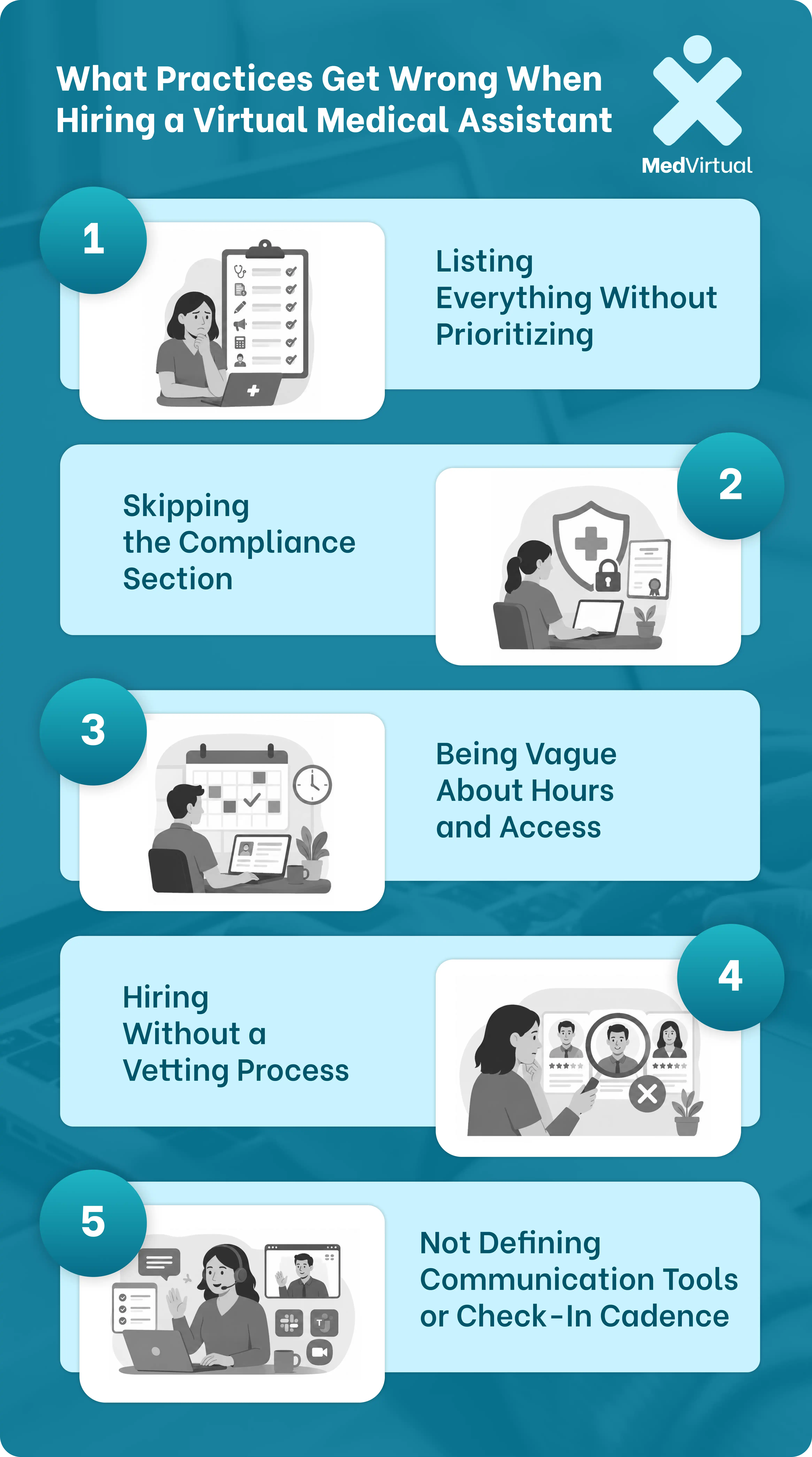
Listing Everything Without Prioritizing
A job description that asks for medical billing, clinical scribing, social media management, bookkeeping, and front desk coverage in the same role sets the VA and the practice up to fail.
Pick 3 to 5 primary responsibilities that reflect your highest-priority needs. Everything else is secondary.
Skipping the Compliance Section
HIPAA training is not a background detail. It belongs in the requirements section, not the footer. Any VA handling patient data must have documented training before they start.
Being Vague About Hours and Access
"Flexible hours" is not a schedule. Remote VAs need to know your exact hours, which systems they will access, and how they will communicate with your team day to day.
Hiring Without a Vetting Process
Posting a job description without a structured vetting process means you are screening candidates based on resumes alone. That misses experience quality, English fluency, and technical proficiency. All of which matter more than the resume.
A proper vetting process includes an EMR proficiency test, an English fluency check, and reference or work history verification. MedVirtual's matching process handles all of this before a candidate is ever presented to your practice.
Not Defining Communication Tools or Check-In Cadence
A remote VA cannot read the room the way an in-office hire can. If your job description does not specify which tools your team uses (whether that is Slack, Teams, or a practice management platform) and how often you expect check-ins, you are setting up a communication gap before the VA even starts.
Specify the communication stack, the daily or weekly check-in format, and who the VA reports to. These details matter as much as the task list.
Skip the Job Description. Let MedVirtual Match You Instead.
Writing a strong virtual medical assistant job description is step one. Screening candidates, testing EMR proficiency, verifying HIPAA training, and managing the hiring process is everything after that.
Every VA placed by MedVirtual is 100% HIPAA-trained, background-checked, and experienced in US healthcare workflows before they are matched to your practice. The average match takes 48 hours. Onboarding starts within 3 to 5 days of your consultation.
Practices across the US trust MedVirtual to find the right fit without the hiring overhead. As David Glick put it: "I can now finally focus on the executive functions of running my clinic." See how our pricing works and what a dedicated VA costs your practice.
You tell us what your practice needs. We find the right person for it.

Your Guide To Common Questions & Solutions