Virtual Assistant for Doctors Office: How to Hire Right

A virtual assistant for a doctors office is a remote, dedicated staff member who handles the administrative, billing, and patient communication tasks that slow a practice down.
If you are reading this, you are past the "what is a virtual assistant" stage. You already know the role exists. What you need now is a clear, practical answer to the harder question: how do you actually hire one that works?
This guide covers exactly that: what tasks to hand off, what to require, how to vet candidates, and what separates a hire that transforms your practice from one that creates more work.
KEY TAKEAWAYS
- A virtual assistant for a medical office handles scheduling, billing, prior authorization, patient communication, and EMR work remotely.
- Practices that define the role before hiring fill it faster and get better results from day one.
- Hiring through a VA company provides pre-verified HIPAA training, EMR matching, and compliance setup that job boards do not.
- MedVirtual matches practices with HIPAA-trained VAs within 48 hours, with onboarding in 3 to 5 days.
What a Virtual Assistant for a Doctors Office Actually Does
The role varies by practice type and size, but most doctors offices hire a virtual assistant for a doctors office to handle one or more of these core areas:
Front Desk and Scheduling
The highest-volume administrative work in any doctors office. A virtual assistant for a medical office handles:
- Scheduling, confirming, and rescheduling patient appointments
- Answering inbound patient calls and routing messages
- Managing the practice inbox and responding to patient inquiries
- Processing referrals and coordinating with specialist offices
- Sending appointment reminders and following up on no-shows
Medical Billing and Insurance
Prior authorization is one of the most time-intensive administrative burdens in private practice, and one of the highest-value tasks to delegate to a virtual assistant. Practices that staff a dedicated VA for prior auth report faster claim approvals, fewer denials, and more predictable revenue cycles. Billing tasks typically include:
- Insurance eligibility verification before each visit
- Claim submission and status tracking
- Following up on denied or unpaid claims
- Payment posting and account reconciliation
- Prior authorization processing for medications and procedures
Clinical and Documentation Support
Depending on the VA's background and your practice type, clinical support tasks can include:
- Real-time or post-visit medical scribing
- Documenting physician notes into the EMR
- Remote patient monitoring data entry
- Sending patient education materials and post-visit care instructions
- Coordinating lab results and next-step communications with patients
Practice Operations
Larger or multi-provider offices often extend the role into operational support:
- Managing vendor communications and supply coordination
- Supporting telehealth visits and virtual patient intake
- Monitoring chronic care management tasks
- Assisting with billing audits and documentation reviews
Why More Private Practices Are Hiring Virtual Assistants Now
Two factors have accelerated the shift toward virtual assistants in doctors offices across the US. Hiring a virtual medical assistant for a private practice has become one of the most practical solutions for independent doctors managing both clinical and operational demands.
The first is rising labor costs. Hiring and retaining in-house medical assistants and receptionists now requires a full package of salary, benefits, payroll taxes, equipment, and office space that adds up to $4,500 to $6,000 or more per month per hire in most US markets.
The second is a real shortage of reliable in-office staff in most markets, making it harder for practices to stay fully staffed without overpaying or compromising on quality.
A dermatology practice in Los Angeles saw this play out directly. Constant front-desk turnover left the clinic stretched thin, calls went unanswered during peak hours, and booking lead times stretched past two weeks. In a competitive market, those delays cost the clinic new appointments.
MedVirtual placed four virtual medical staff trained in healthcare administration and HIPAA-aligned workflows. The results over 12 months:
- 4 virtual medical staff hired
- $156,000 in annual cost savings
- 18,000+ patients managed annually
- 100% staff retention over 12 months
"Back office work was always a struggle for us because of constant turnover. Our front desk stayed stretched thin, and we were losing patients simply because we could not get them booked. Bringing on virtual medical staff gave our in-office team room to breathe, and the workload finally felt manageable again."
– Dr. Amanda J., Practice Manager | Los Angeles Dermatology Clinic
The shift is not about cutting corners. It is about putting the right work in the right hands.
Virtual Assistant for Medical Office: Hire Direct or Through a Company?
This is the first real decision practice owners face. Both paths have trade-offs.
Job boards like ZipRecruiter and Indeed return a high volume of applicants. Most are entry-level candidates with no US healthcare workflow experience, no EMR proficiency, and no HIPAA training. Screening for those qualities from a pool of hundreds of applicants is time-consuming and often produces disappointing results.
A VA company pre-screens for all of it. You get a shortlist of candidates who already meet your requirements.
For a doctors office that cannot afford a 60-day trial-and-error hiring process, the company model is the practical choice.
How to Hire a Virtual Assistant for a Doctors Office: Step by Step
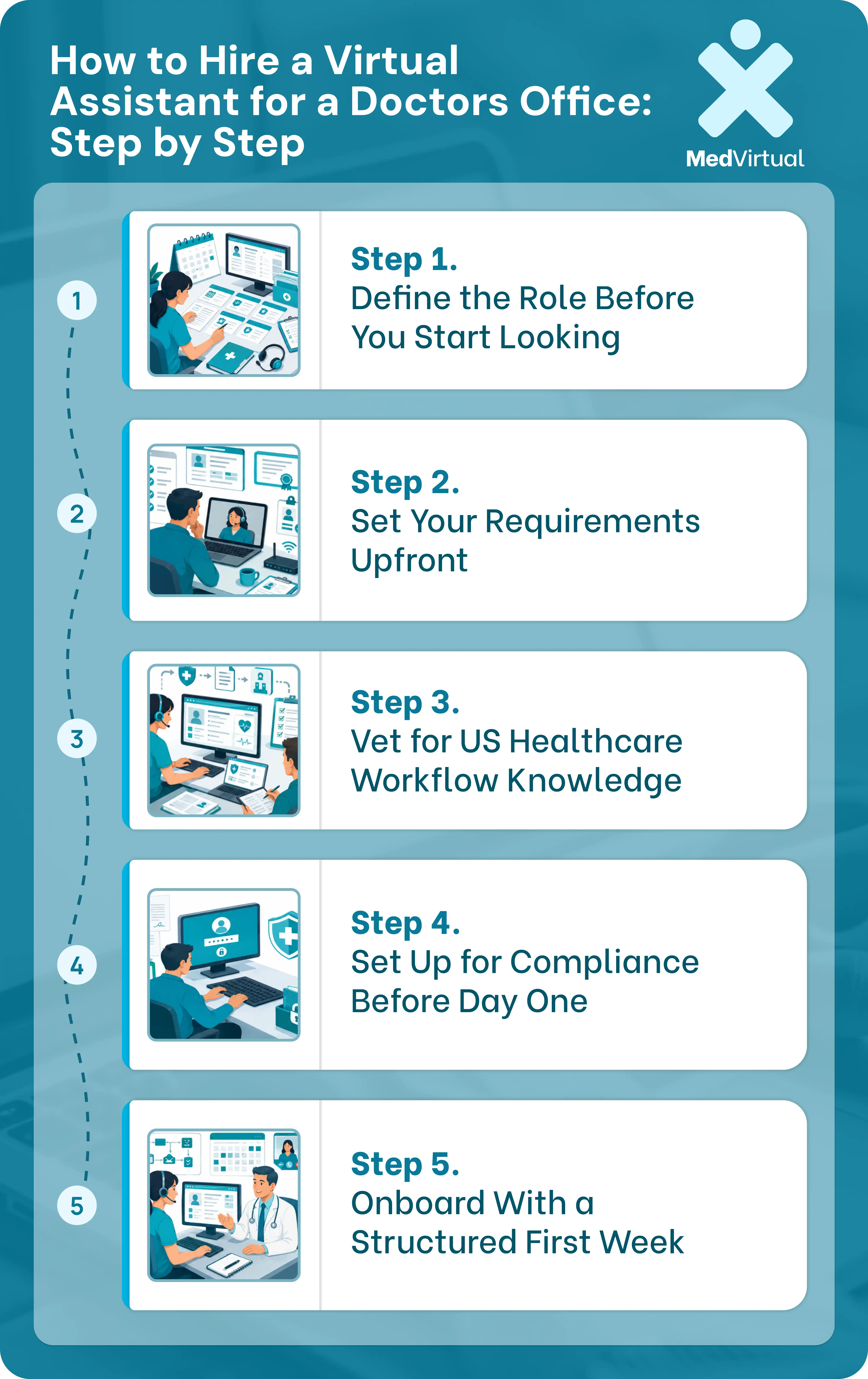
Step 1. Define the Role Before You Start Looking
Write down the three to five tasks that consume the most time in your office right now. That is the core of the role. Defining medical office virtual assistant duties clearly before you start evaluating candidates is the single most important step in the hiring process. Resist the temptation to list everything. A VA hired to do everything will do nothing particularly well.
Common starting points by practice type:
- Primary care: scheduling, inbox management, insurance verification
- Specialty clinic: prior authorization, referral coordination, EMR documentation
- Surgery center: pre-op coordination, insurance verification, post-op follow-up
- Multi-provider: multi-calendar management, billing oversight, patient communication
Step 2. Set Your Requirements Upfront
Before evaluating any candidate, know what you require. At minimum:
- Minimum 1 to 2 years of US healthcare administrative experience
- Hands-on experience with your specific EMR system
- Completed HIPAA training with documentation
- Signed BAA before accessing any patient data
- Fluent English communication, written and verbal
- Reliable high-speed internet, dedicated workspace, backup power
If your practice uses a specific billing platform or specialty workflow, add that to the requirements list before you start evaluating anyone.
Step 3. Vet for US Healthcare Workflow Knowledge
Resume experience does not equal workflow competency. A candidate who has worked in a doctors office in another country for five years may have no familiarity with US insurance systems, EMR workflows, prior authorization processes, or payer-specific requirements.
Vetting should include:
- An EMR proficiency test on your specific system
- A scenario-based assessment covering insurance verification or claim submission
- An English fluency check, both written and verbal
- Reference verification from a previous US healthcare employer
If you are hiring through a VA company, confirm that these checks are completed before the candidate is presented to you. Not after.
Step 4. Set Up for Compliance Before Day One
Before your VA accesses anything in your practice, three documents must be in place:
- Signed Business Associate Agreement (BAA)
- Signed NDA and confidentiality agreement
- Role-based access controls that limit the VA to the systems and data they need
HIPAA training must also be completed and documented before the first day. Not on the first day. Before it. This is not optional for any virtual assistant handling patient data in a US doctors office.
Step 5. Onboard With a Structured First Week
The first week sets the tone for everything that follows. A structured onboarding covers:
- System access setup and login verification
- Walkthrough of your practice's specific workflows
- Introduction to your scheduling protocol, inbox rules, and communication preferences
- A defined check-in cadence for the first 30 days
- Clear KPIs for what a successful first month looks like
Practices that skip structured onboarding and assume the VA will figure it out typically see poor performance in the first 30 days and attribute it to the VA rather than the process.
When the process is right, the results follow. As Chami Chedrick of Rivertown Psychiatry put it: "Hiring has never been easier for our practice."
What to Look for in a Virtual Assistant for a Medical Office
Beyond credentials and experience, the qualities that separate a high-performing medical VA from an average one are consistent across practice types:

Self-Direction
A virtual assistant for a doctors office works without in-person supervision. They need to manage their own workflow, flag issues proactively, and complete tasks without needing daily hand-holding.
A self-directed VA, for example, notices a claim denial in the system and follows up with the payer before the practice manager even sees it. Ask for examples of exactly this kind of proactive task management in previous roles.
Detail Accuracy Under Volume
Billing errors, documentation mistakes, and scheduling conflicts all trace back to attention to detail under a high volume of repetitive tasks. In the vetting process, test for this directly rather than asking the candidate to self-assess.
A practical test that works: give the candidate a sample patient record with two or three deliberate errors in the billing fields and ask them to identify and correct them within a set time. What they catch and how fast they catch it tells you more than any resume line.
Patient Communication Skills
Any VA handling patient calls, portal messages, or follow-up outreach is an extension of your practice's front desk. Their communication style directly affects patient experience and retention. Listen to a sample call or review written communication samples before making a decision.
HIPAA Awareness in Practice
HIPAA training is a checkbox. HIPAA awareness is a behavior. Ask scenario-based questions about what the VA would do if they accidentally accessed the wrong patient record, received a request for patient information by phone, or noticed a potential data breach. How they answer matters as much as whether they have the certificate.
Ready to Hire a Virtual Assistant for Your Doctors Office?
MedVirtual gives you a pre-vetted, HIPAA-trained VA match in 48 hours. No job posting, no screening, no six-week wait. Every VA is already experienced in US healthcare workflows, pre-matched to your EMR, and ready to start within 3 to 5 days of your consultation.
250+ US medical practices already trust MedVirtual to staff their operations. Your next hire is ready.

Your Guide To Common Questions & Solutions