Medical Administrative Assistant for Clinics: Roles and Benefits

Every well-run clinic depends on strong administrative support. Physicians can only focus on patients when someone else is handling the scheduling, the insurance calls, the records, the billing follow-ups, and the dozens of other operational tasks that keep a practice functional.
That someone is the medical administrative assistant.
For clinics evaluating their administrative staffing, understanding what this role actually covers, how it differs from other support positions, and what the benefits of virtual staffing look like is the starting point for making a good decision. This article covers all three.
What Is a Medical Administrative Assistant?
A medical administrative assistant (MAA) is a trained professional who manages the non-clinical operational functions of a healthcare practice. They are the organizational backbone of a clinic, handling the administrative tasks that allow physicians, nurses, and clinical staff to stay focused on patient care.
Unlike a medical assistant, who may perform clinical duties such as taking vitals or assisting with procedures, a medical administrative assistant works exclusively on the administrative side. Their responsibilities sit at the intersection of patient communication, healthcare compliance, data management, and operational coordination.
In modern practices, this role is increasingly filled by virtual professionals who work remotely inside the clinic's existing systems, delivering the same administrative output as an in-office employee without the associated overhead costs.
Core Roles of a Medical Administrative Assistant in a Clinic
Patient Scheduling and Coordination
Scheduling is often the most visible function of the medical administrative assistant. They manage the appointment calendar, book new and return visits, handle rescheduling and cancellations, send confirmation messages, and coordinate appointment reminders to reduce no-shows.
In busy practices, the scheduling function alone can consume the majority of front desk capacity. A dedicated administrative assistant who owns this responsibility keeps the calendar organized and ensures the physician's time is used efficiently every day.
Insurance Verification and Prior Authorization
Before a patient arrives for an appointment, their insurance eligibility should already be confirmed. A medical administrative assistant verifies coverage, checks benefit details, and identifies any prior authorization requirements for procedures, referrals, or prescriptions that need to be initiated before the visit.
This proactive work prevents claim denials, reduces billing delays, and eliminates the last-minute coverage surprises that create friction for both patients and front desk staff on the day of the appointment.
EHR and Medical Records Management
Accurate electronic health record (EHR) management is both an operational and a compliance requirement. The medical administrative assistant maintains patient records, updates demographic and insurance information, enters intake data, manages document uploads such as referral letters and lab results, and ensures that records are structured correctly for clinical and billing use.
Proficiency with major EHR platforms, including Epic, Athenahealth, eClinicalWorks, and Kareo, is a core competency for any experienced medical administrative assistant. MedVirtual's medical administrative assistants are trained on the EHR systems their clinic clients already use, enabling fast integration with minimal onboarding disruption.
Billing Support and Claims Follow-Up
While dedicated medical billers handle full revenue cycle management, a medical administrative assistant often provides critical front-end billing support. This includes collecting accurate patient information at intake, verifying that insurance and coding data is complete before submission, following up on pending claims, and handling basic billing inquiries from patients.
This coordination layer between the administrative and billing functions reduces the volume of claim errors that reach the billing team, improving first-pass acceptance rates and accelerating revenue cycles. For practices looking for full billing support, MedVirtual provides dedicated medical billers as a separate, complementary service.
Patient Communication and Intake
The medical administrative assistant is often the first point of contact for patients, both by phone and through patient portals. They answer inbound calls, respond to patient inquiries, manage secure messaging, process new patient intake forms, and handle the administrative steps of onboarding new patients to the practice.
The quality of this communication directly affects patient experience and retention. Patients who receive timely, professional, and warm administrative interactions are more likely to return and to recommend the practice. Those who encounter delays, confusion, or impersonal responses are more likely to seek care elsewhere.
Referral and Care Coordination
When a patient needs to see a specialist, the referral process requires careful administrative management. The medical administrative assistant coordinates the referral paperwork, confirms receipt with the receiving provider, tracks the status of the referral, and ensures that any documentation required by the specialist is transmitted securely and completely.
In practices that manage patients with complex or chronic conditions, this coordination function is particularly important for continuity of care and for maintaining strong relationships with referring providers.
Junior vs. Senior Medical Administrative Assistant: What Is the Difference?
The scope of responsibility for a medical administrative assistant scales with experience level, and clinics should match the role level to their actual operational complexity.
A junior medical administrative assistant handles the foundational administrative tasks: scheduling, patient intake, answering calls, updating basic EHR records, and managing correspondence. They work under closer supervision and are well-suited for smaller practices or clinics that need solid front desk support without high-complexity workflow management.
A senior medical administrative assistant takes on more independently managed responsibilities: overseeing insurance verification and prior authorization, managing billing support workflows, handling complex scheduling across multiple providers, coordinating referrals, and sometimes supervising junior administrative staff. They require less oversight and are better suited for multi-provider practices or high-volume specialty clinics.
At MedVirtual, junior medical administrative assistants are available starting at $11 per hour for English-only roles, while senior medical administrative assistants start at $13 per hour, with no employer overhead on top of either rate. Bilingual options are available at $12 and $14 per hour respectively, which is valuable for practices serving diverse patient populations.
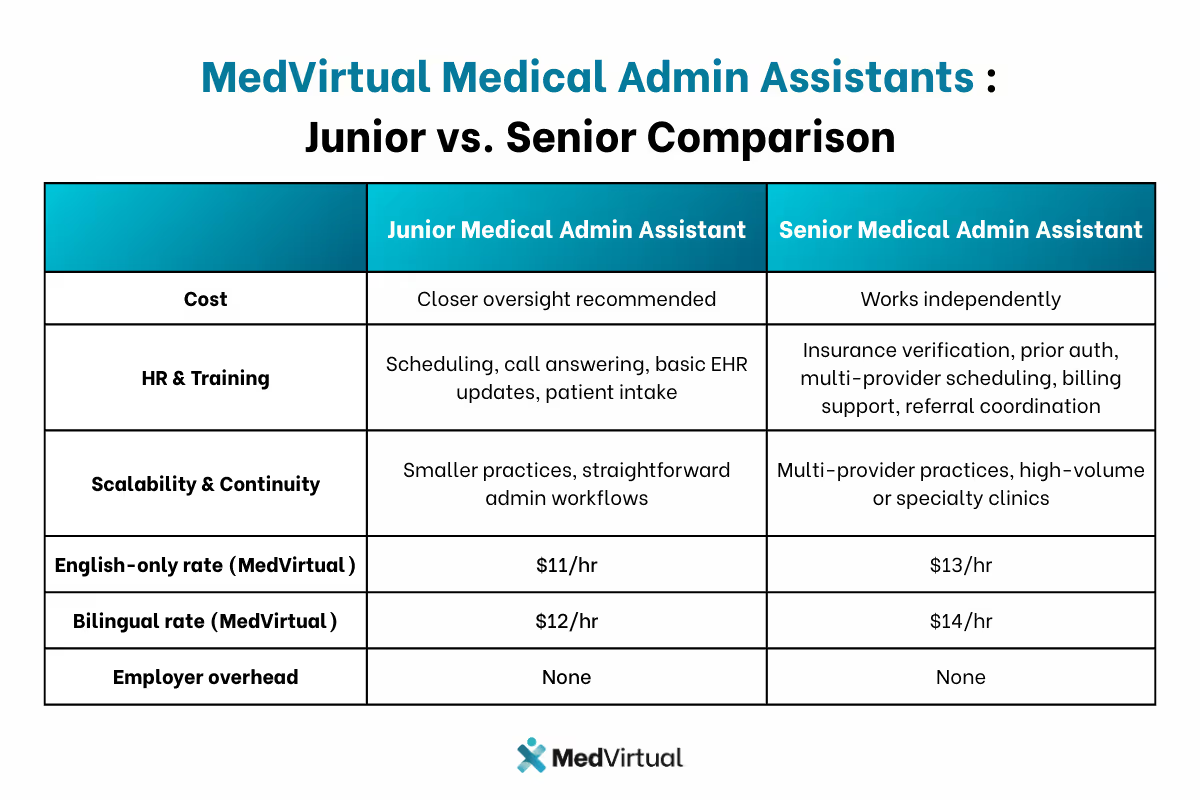
Rates are for virtual staffing via MedVirtual. No payroll taxes, benefits, or workspace costs apply.
The Benefits of a Medical Administrative Assistant for Your Clinic
Physicians Reclaim Clinical Time
Administrative overload is one of the leading drivers of physician burnout. When physicians or nurses are pulled into scheduling calls, insurance questions, or records management because there is insufficient administrative support, their clinical capacity shrinks and their job satisfaction suffers. A dedicated medical administrative assistant absorbs that burden and restores the clinical team's focus where it belongs.
Operational Efficiency Improves Across the Practice
When administrative tasks are handled consistently by a trained professional, the ripple effect is felt across every part of the practice. Scheduling is tighter. Insurance issues are caught before the appointment. Records are accurate when the physician needs them. Billing has cleaner front-end data. Each of these improvements compounds over time into a materially more efficient operation.
Patient Experience Gets Better
Patients notice administrative quality, even when they cannot articulate it. When calls are answered promptly, intake is smooth, reminders arrive reliably, and questions are handled professionally, patients feel that the practice values their time and takes their care seriously. That perception drives retention and referrals.
Virtual Staffing Reduces Overhead Without Reducing Quality
Hiring a full-time in-house medical administrative assistant carries significant overhead. Beyond the base salary of $37,000 to $44,000 per year, the employer adds payroll taxes, health benefits, paid time off, and workspace costs, bringing the total annual cost to $50,000 or more.
A virtual medical administrative assistant through a healthcare-specific partner like MedVirtual delivers the same operational functions at a fraction of that cost, with no employer overhead, no office space required, and no disruption when the individual needs time off. The staffing partner handles replacement and continuity.
For a deeper look at how virtual and in-house administrative models compare across a range of factors, the MedVirtual article on in-house vs. virtual medical admin assistants provides a detailed side-by-side analysis.
Which Clinic Types Benefit Most
Virtually any outpatient practice gains from a well-staffed administrative function, but certain clinic types see the sharpest operational impact.
Solo and small group practices, where every administrative gap lands directly on the physician or a single front desk employee, benefit immediately from dedicated administrative support. Multi-provider practices with complex scheduling and high billing volume benefit from a senior-level administrative assistant who can independently manage workflows across the full team.
Specialty practices, where insurance verification and prior authorization are particularly complex, such as cardiology, orthopedics, neurology, and oncology, benefit from an administrative assistant with specialty-specific training who understands those payer and documentation requirements.
Dental practices also rely heavily on medical administrative assistants for treatment scheduling, insurance coordination, and patient communication. MedVirtual provides dedicated dental administrative assistants for dental-specific workflows.
Getting Started with MedVirtual
MedVirtual places HIPAA-trained, healthcare-experienced medical administrative assistants with clinics across the United States. Each assistant is vetted for medical office experience, English proficiency, and familiarity with U.S. healthcare systems before placement.
You can explore the virtual staffing options or contact the team to discuss your practice's administrative needs and find the right role level for your situation.

Conclusion
A medical administrative assistant is not a luxury for well-funded practices. They are the operational infrastructure that allows clinics to function at their full clinical capacity. When that function is filled by a well-trained professional, whether in-office or virtual, physicians can focus on care, patients experience a higher standard of service, and the practice runs with less friction and greater financial efficiency.
For clinics that have been managing without dedicated administrative support, or that are experiencing the cost pressure of in-house staffing, virtual medical administrative assistants represent one of the most accessible and impactful operational investments available today.
Your Guide To Common Questions & Solutions