Virtual Receptionist Services for Medical Practices: What You Actually Need

Most medical practices searching for virtual receptionist services for medical practices end up evaluating the wrong category of service entirely. The market is dominated by shared answering services billed by the minute, with no knowledge of your EMR, your providers, or your protocols. They answer the phone, take a message, and send it to your inbox. That is not what a growing practice needs.
This article breaks down what virtual receptionist services for medical practices actually include, what separates a dedicated virtual receptionist from a shared answering service, and what your practice must verify before placing anyone in a front-office role.
Key Takeaways
- Most virtual receptionist services for medical practices are shared answering services billed by the minute that do not integrate into your EMR or perform front-office functions.
- A dedicated virtual receptionist works exclusively for your practice inside your existing systems, performing the same functions as an in-house front desk hire at a fraction of the cost.
- HIPAA compliance requires a signed BAA, documented training, encrypted communications, and role-based access controls. A phone answering service is not automatically HIPAA compliant.
- A dedicated virtual receptionist can be placed and operational within 3 to 5 days, pre-matched to your EMR and scheduling systems.
What Virtual Receptionist Services for Medical Practices Actually Are
The term "virtual receptionist" covers a spectrum of service models that are not equivalent. Understanding the difference is the first step in evaluating any provider.
Shared answering services operate a pool of agents who handle calls for multiple practices. When your practice forwards calls, an agent picks up, follows a script customized to your practice, takes a message or books an appointment using an integration with your scheduling software, and routes the message back to you. Billing is typically per minute or per call. The agent handling your call today may not be the same agent handling it tomorrow.
WellReceived, ReceptionHQ, Ruby, and similar providers operate in this category. They are valuable for after-hours coverage, overflow calls, and practices that primarily need call routing. They are not a replacement for a front-desk hire.
Dedicated virtual receptionists are assigned exclusively to your practice, work your practice's hours, and operate inside your EMR, scheduling platform, and communication systems as a full-time team member. They know your providers, your protocols, and your patients. They perform the same administrative functions as an in-house hire: scheduling, insurance verification, chart updates, prior authorization intake, and patient communication.
This is the model that replaces an in-house front desk position, not supplements it.
What a Medical Practice Actually Needs From Virtual Receptionist Services
The front desk is the operational center of a medical practice. When it is functioning correctly, patients are scheduled on time, insurance is verified before appointments, calls are answered, and provider inboxes stay clear. When it is overwhelmed or understaffed, every downstream function degrades.
A shared answering service handles one part of that function: inbound call volume. A dedicated virtual receptionist handles the full cycle.
Here is what a medical practice actually needs from a front-desk-level virtual receptionist:
Inbound call handling with clinical context. Not just answering the phone and taking a message, but triaging the call appropriately: scheduling the right appointment type, routing clinical questions to the correct staff member, and identifying urgent situations that require immediate escalation.
Scheduling in your actual system. Direct access to your scheduling platform, not a third-party integration that approximates your availability. The virtual receptionist books appointments the way your in-house staff would, with knowledge of your provider preferences, appointment types, and scheduling rules.
Insurance verification and eligibility checks. Confirming insurance coverage and eligibility before appointments prevents claim denials and patient disputes at checkout. This is a standard front-office function that answering services do not perform.
EMR chart updates and patient data management. Updating demographic information, documenting call interactions, and completing intake data in your EMR before the appointment. This requires direct EMR access, not a message relay.
Prior authorization intake and referral coordination. Collecting the information needed to initiate prior authorizations and referrals before the clinical team needs to act on them. This reduces the administrative burden on nurses and clinical staff.
Portal message triage. Reviewing and routing patient portal messages to the appropriate staff member so providers are not managing their own inbox for administrative requests.
The 6 Tasks a HIPAA-Trained Dedicated Virtual Receptionist Handles
A dedicated virtual receptionist for a medical practice covers every front-office function that an in-house hire would:
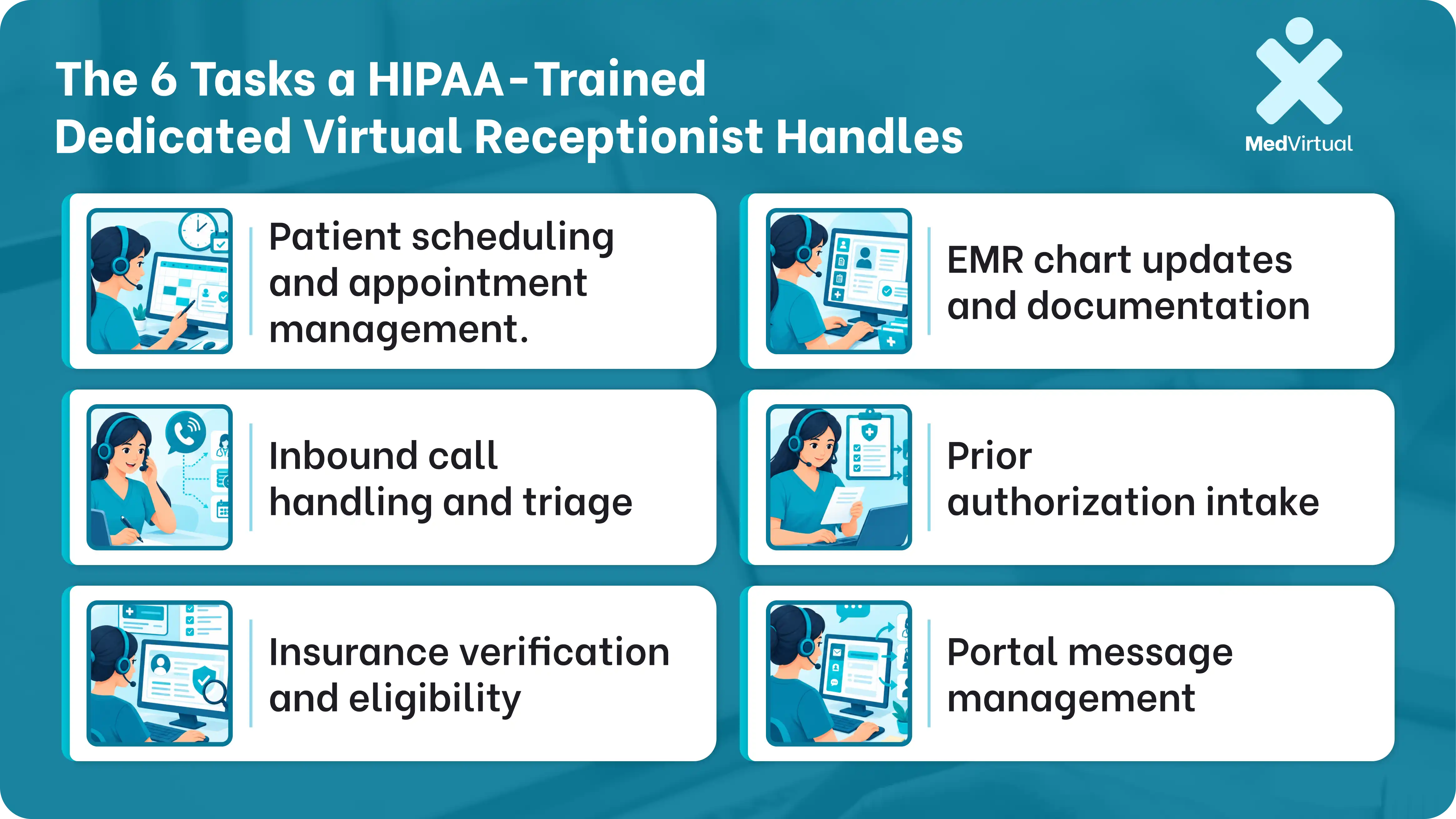
1. Patient scheduling and appointment management
Books, confirms, reschedules, and cancels appointments directly in your scheduling system. Manages provider calendars and fills scheduling gaps proactively.
2. Inbound call handling and triage
Answers inbound calls, identifies the nature of the call, and routes it appropriately. Clinical questions go to clinical staff. Billing questions go to billing. Scheduling requests are handled directly.
3. Insurance verification and eligibility
Verifies coverage and benefits before every appointment using your payer portals. Flags any issues that could delay or complicate the visit before the patient arrives.
4. EMR chart updates and documentation
Updates patient demographics, documents call interactions, and completes intake data in your EMR. Records are current before the provider enters the room.
5. Prior authorization intake
Collects the clinical information required to initiate prior authorizations and routes it to the appropriate staff member or submits directly, depending on your workflow.
6. Portal message management
Reviews incoming portal messages, routes administrative requests, and ensures clinical messages reach the appropriate provider or nurse without delay.
HIPAA Compliance Requirements for a Virtual Receptionist
Every virtual receptionist in a healthcare setting handles Protected Health Information on every patient interaction. HIPAA applies to any vendor who accesses, processes, or transmits PHI on behalf of a covered entity, including a virtual receptionist service.
A shared answering service that does not have a signed Business Associate Agreement with your practice is not HIPAA compliant regardless of what their marketing says. Before placing any virtual receptionist in a front-office role, verify:
Signed Business Associate Agreement. Required before any PHI is accessed. Non-negotiable.
Documented HIPAA and PHI training. Every team member who handles patient information must have completed training before they start. Ask for documentation.
Encrypted communications. All patient-related communications must move through encrypted channels. Standard phone and email are not HIPAA-compliant without additional security controls.
Role-based access controls. The virtual receptionist should have access only to the systems and data fields required for their role. Full chart access for a receptionist who handles scheduling creates unnecessary breach risk.
Monitored workstations and activity logging. Remote access to your systems should be monitored. Activity logging creates an audit trail required under HIPAA.
Six (6) Evaluating Questions for a Virtual Receptionist Services for Your Medical Practice
The questions that separate genuine virtual receptionist services for medical practices from call handling services:

1. Is this a dedicated placement or a shared pool?
If the same person is not handling your calls every day, you have an answering service, not a virtual receptionist.
2. Do they work inside your EMR?
If they cannot access and update your scheduling and patient records directly, they are not performing front-desk functions.
3. Can they produce the BAA before you sign anything?
Any service that requires a commitment before sharing their BAA is a flag.
4. What is their HIPAA training documentation?
Named program, timeline, renewal schedule. If the answer is vague, the training may not exist.
5. What happens when the placement is not right?
A dedicated placement model should include a replacement guarantee at no extra cost. A shared answering service does not have a placement to replace.
6. What is the hourly or monthly cost, and what does it include?
Per-minute billing makes it difficult to forecast total cost. An hourly or flat-rate dedicated placement gives you predictable pricing and consistent coverage.
Your Practice Deserves a Virtual Receptionist Who Actually Works Like One
MedVirtual places dedicated, HIPAA-trained virtual medical receptionists, built around the compliance and integration standards that virtual receptionist services for medical practices actually require, inside your existing systems, pre-matched to your EMR and scheduling platform before day one. Most practices are live within 3 to 5 days of the free consultation.
For a broader look at how virtual receptionist services work inside a medical practice, read Virtual Medical Receptionist Services for Healthcare Practices.
Your Guide To Common Questions & Solutions