Virtual Receptionist for Doctors: How to Choose the Right One

Every unanswered call to a doctor's office is a patient deciding whether to try the next number. A virtual receptionist for doctors is a remote, trained team member who answers calls, books appointments, and handles patient messages, and MedVirtual's starts at $10 per hour.
This guide compares the four ways to staff a front desk: an in-house hire, an answering service, a dedicated virtual receptionist, and AI. It then covers what a virtual receptionist handles, a checklist for choosing one, and how MedVirtual places one.
Key Takeaways
- Four models, four jobs. An in-house hire, an answering service, a dedicated virtual receptionist, and AI each fit a different call volume and practice size.
- Dedicated means one person. A dedicated virtual receptionist is trained on your providers and systems and billed at a flat hourly rate, which starts at $10 with MedVirtual.
- Choose on fit and accountability. A BAA, EMR experience, coverage hours, and a named contact matter as much as price.
- Clinical decisions stay with your team. Under every model, advice, triage, and treatment decisions belong to licensed staff.
What a Virtual Receptionist for Doctors Is and What It Costs
A virtual receptionist for doctors works your phones and front-desk tasks remotely, as part of your team. With MedVirtual, that is one dedicated person who works only for your practice.
The cost starts at $10 per hour on a flat hourly rate, with no long-term commitment. Other models price differently, so compare the full cost along with the headline rate.
Who a Virtual Receptionist for Doctors Fits
Practice size and call volume decide which model fits. This table matches common situations to the model that usually suits them.
For a deeper look at how these services work day to day, see our guide to virtual receptionist services for medical practices.
The Four Front-Desk Options Compared
Each option solves a different problem. The table compares them on the points that matter most when you are choosing.
Prices are starting points and change often, so confirm current rates. For how AI and people divide the work on patient calls, see our page on human virtual assistants and AI.
Five (5) Things a Virtual Receptionist Handles
A dedicated virtual receptionist covers the front-desk work that can be done remotely. It follows the scripts and escalation rules you set.
Calls and Messages
They answer inbound calls, take messages, and route calls according to your rules. Calls that need a clinician go to your team.
Appointment Scheduling
They book, confirm, and reschedule appointments around the provider preferences you document. The more clearly your scheduling rules are written down, the fewer exceptions come back to your staff.
Patient Check-In
They support patient check-in, so your on-site staff can focus on the people standing at the counter. Confirm the exact check-in tasks for your practice on the role page, since greeting patients in person stays with your on-site team.
Basic Billing Questions
They answer routine billing questions and pass complex ones to your billing team. For deeper insurance and billing work, a billing or admin role is the better fit.
What Stays With Your Team
Clinical advice, triage, and treatment decisions stay with your licensed clinical staff. A virtual receptionist routes those calls to them for the answer.
Checklist to Choose the Best Virtual Medical Receptionist
Use this checklist with any provider, including MedVirtual. The best virtual medical receptionist for your practice is the one that meets most of these criteria for your situation.
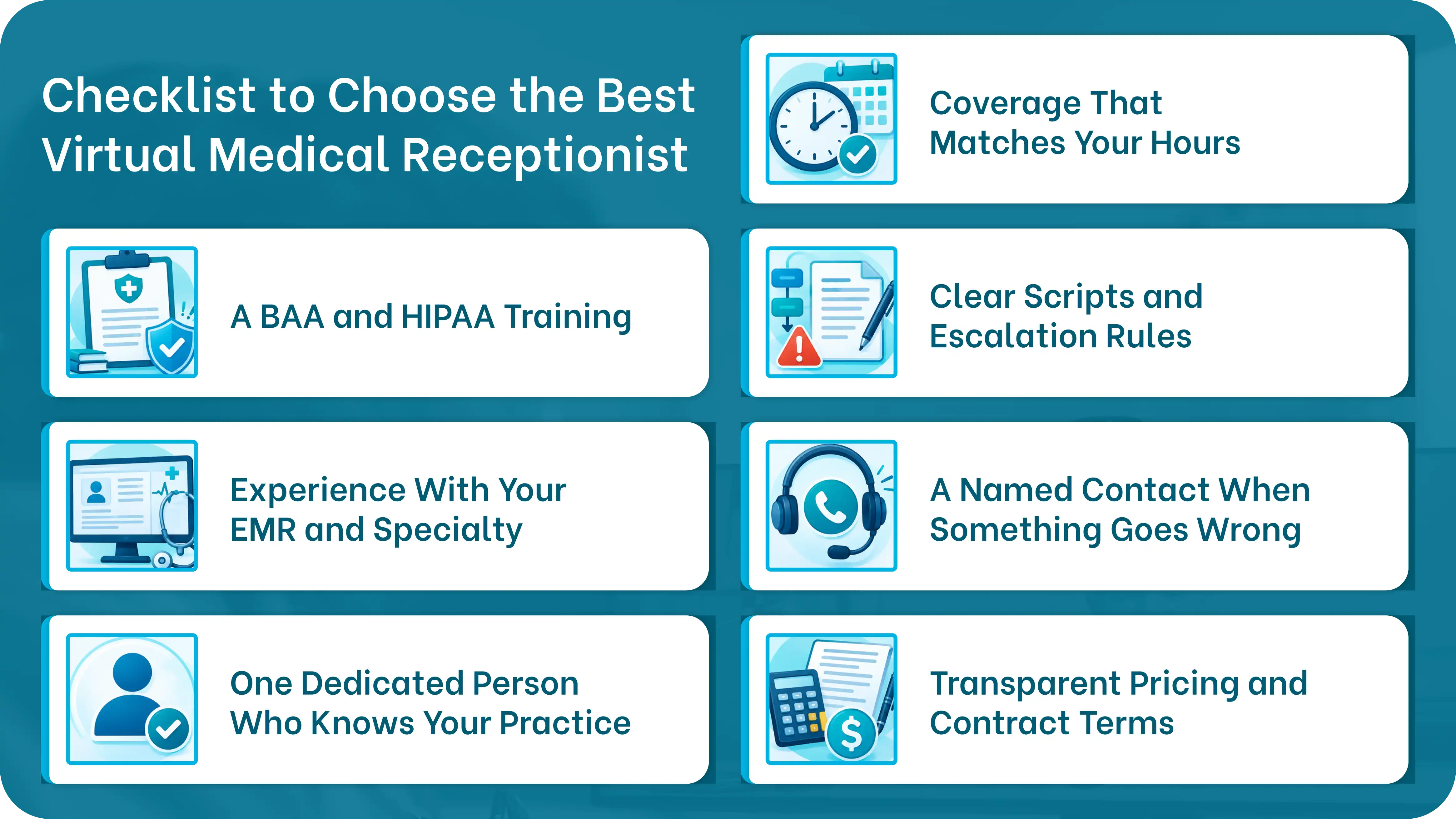
A BAA and HIPAA Training
A vendor that handles patient information for your practice is generally a business associate, and a written BAA is expected. Ask for the agreement itself and for confirmation that the receptionist completed HIPAA and PHI training before touching patient data.
Experience With Your EMR and Specialty
A receptionist who already knows your EMR and the rhythm of your specialty ramps up faster. Ask how candidates are matched, and whether you can interview the person you will work with.
One Dedicated Person Who Knows Your Practice
A shared pool means a different voice each call and no one who knows your providers. A dedicated person learns your schedule, your patients, and your preferences.
Coverage That Matches Your Hours
Confirm the hours and time zones the receptionist will work, and what happens when they are out. A gap in coverage means a caller reaches voicemail instead of a person.
Clear Scripts and Escalation Rules
Ask who writes the scripts, who updates them, and which calls go straight to a clinician. Clear triggers for distress, urgent symptoms, and billing disputes protect both patients and staff.
A Named Contact When Something Goes Wrong
You should know who to call when a claim, a booking, or a message goes wrong. A staffing provider with a named account contact is easier to hold accountable than a ticket queue.
Transparent Pricing and Contract Terms
Ask for the rate structure, any minimums or overage charges, and how to change or end the arrangement. Flat hourly pricing with no long-term commitment makes the cost easier to predict.
How MedVirtual Places a Virtual Receptionist
MedVirtual places dedicated, full-time virtual receptionists into US medical practices. Every virtual assistant is HIPAA-trained, and a signed BAA is in place before Day One, with role-based access controls and activity logging.

The process moves in four steps:
- Consultation. You tell us your call volume, hours, EMR, and specialty.
- Matching. A candidate is matched within 48 hours.
- Onboarding. Onboarding takes 3 to 5 days after the consultation.
- 90-Day Incubation Program. A named Client Success Manager runs check-ins and KPI tracking from Day One.
Pricing starts at $10 per hour. See the Virtual Medical Receptionist page for the role in detail.
Choosing a Virtual Receptionist for Doctors
Choosing a virtual receptionist for doctors comes down to fit: your call volume, your hours, and how much accountability you need. Match the model, confirm the BAA, and compare the full cost across all four options.
Book a Consultation to talk through which front-desk model fits your practice.
Your Guide To Common Questions & Solutions