Outsource Prior Authorization: Services, Costs, and Options

Every prior authorization your front desk handles is time that is not spent on patients, which is why more practices want to outsource prior authorization. You have three real options: an in-house coordinator, a dedicated virtual assistant, or a prior authorization services company, and each fits a different practice.
This guide compares the three on cost, control, speed, and accountability, then covers what to hand off, a cost comparison with labeled assumptions, and how to get started. It builds on our guide to prior authorization tasks, so it focuses on choosing a model.
Key Takeaways
- Three models, three trade-offs. In-house gives the most control at the highest cost, a dedicated virtual assistant gives direct control at an hourly rate, and a services company removes management but follows its own process.
- Cost depends on volume. A 40-hour week costs about $1,290 in-house and $400 at MedVirtual's starting rate of $10 per hour, while a per-request service gets cheaper below a break-even volume.
- Hand off the administrative steps. Clinical judgment, such as medical necessity and appeals decisions, stays with your clinical staff.
- Start with data. Build a payer list, track turnaround times, and set up EMR access before you choose a model.
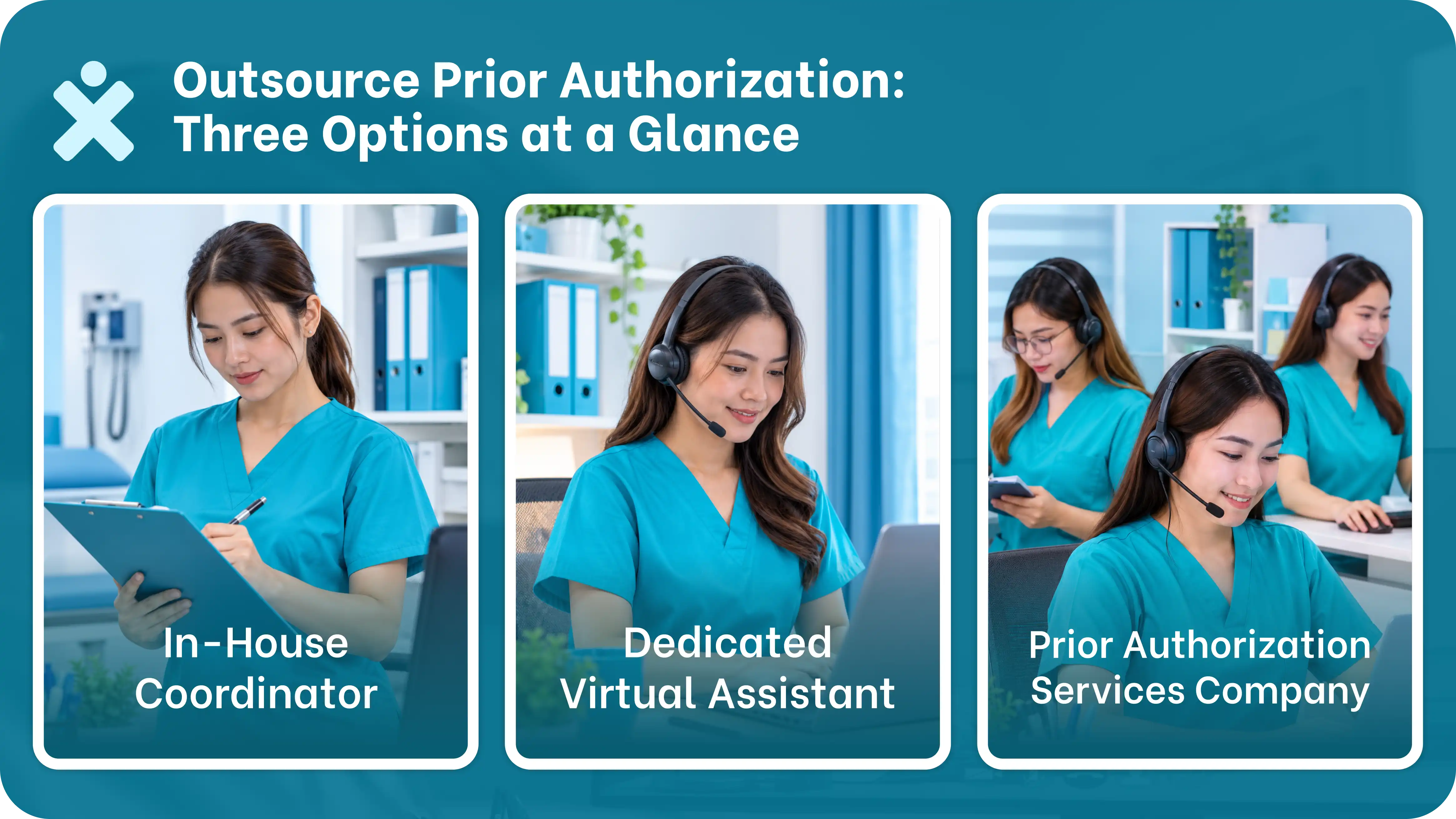
Outsource Prior Authorization: Three Options at a Glance
You can outsource prior authorization in three ways: keep it in-house with a dedicated coordinator, hire a dedicated virtual assistant, or use a prior authorization services company. In-house gives the most control at the highest cost, a dedicated virtual assistant adds direct control at a lower hourly rate, and a services company removes management but follows its own process.
The workload is large enough to justify the decision. Physicians complete an average of 40 prior authorizations per week, and 40% employ staff who work exclusively on prior authorization, according to the 2025 AMA Prior Authorization Physician Survey of 1,000 practicing physicians.
In-House Coordinator
An employee at your practice owns the work, and you control the process, priorities, and training. This fits a practice with steady volume that can recruit, train, and cover absences. You carry the full cost of the role, including benefits and overhead.
Dedicated Virtual Assistant
A dedicated prior authorization virtual assistant works only for your practice, in US time zones, on the administrative steps. This fits a practice with a steady workload for one person that wants direct control without a local hire.
With MedVirtual, the assistant is HIPAA-trained, a signed BAA is in place before Day One, and your practice manages the work day to day while MedVirtual handles HR, tax, and contracts.
Prior Authorization Services Company
An outside company takes your requests and handles them with a shared team. Prior authorization services fit a practice with uneven volume or no capacity to manage a person. The work follows the company's process, so ask how it reports status and who answers clinical questions.
Which Way to Outsource Prior Authorization Fits?
The table compares the three models on the six criteria that matter most when you choose.
What to Hand Off and What Stays With Clinicians
Hand off the administrative steps, and keep every decision that needs clinical judgment with licensed clinical staff. This line holds in all three models.
Clinical decisions, record interpretation, and medical advice stay with your clinical staff. Whoever handles the work needs access to your systems, so require a signed BAA before any patient information is shared.
Outsource Prior Authorization: Cost Comparison
To compare the models, convert each to a cost per hour of work and per request. Every input below is an assumption unless noted, so replace each one with your own numbers.
The math, step by step:
MedVirtual bills hourly, so the per-request figure is the hourly rate times the time one request takes. The services company fee covers its work only, and you still do the work you retain, such as gathering documents and answering clinical questions.
Here is how cost moves with weekly volume, using a $9 per-request fee as an illustration within the $4 to $15 range.
The in-house and dedicated assistant columns are fixed weekly costs, and the services company column grows with volume. The weekly requests at which a per-request fee equals $400 are $400 ÷ fee.
Below those volumes, a per-request service costs less than a full-time dedicated assistant, and above them the assistant costs less. These are estimates built on assumptions, and they leave out quality, rework, and your oversight time.
How to Get Started
Three steps give you the data to choose a model and to brief whoever takes the work.
Build Your Payer List
List every payer that requires prior authorization and the services affected. Note each payer's submission channel and the documents it asks for. This list becomes the playbook for whoever handles the requests.
Track Turnaround Times
Log the date requested, the date submitted, the decision due date, and the date resolved for every request. After a few weeks, you can see where requests stall and how many a week you actually handle. That volume is the number the cost comparison needs.
Set Up EMR and Portal Access
Decide which systems the person or team needs and give role-based access to only those. Confirm a signed BAA is in place before anyone sees patient information. MedVirtual matches each assistant to your EMR, and access is role-based.
What CMS-0057-F Means for Your Choice
The CMS-0057-F rule requires covered payers to decide expedited requests within 72 hours and standard requests within seven calendar days, excluding qualified health plan issuers on the federally facilitated exchanges. It places its main requirements on payers, so you still manage the requests.
Whichever model you choose, use those deadlines as the due dates in your tracker.
How to Outsource Prior Authorization Well
The best way to outsource prior authorization starts with your own numbers: your payer list, your weekly volume, and the time each request takes. Match the model to that data, and keep clinical decisions with your clinical team.

Book a Consultation to see which prior authorization model fits your practice.
Your Guide To Common Questions & Solutions