What a Virtual Assistant Handles in Prior Authorizations?
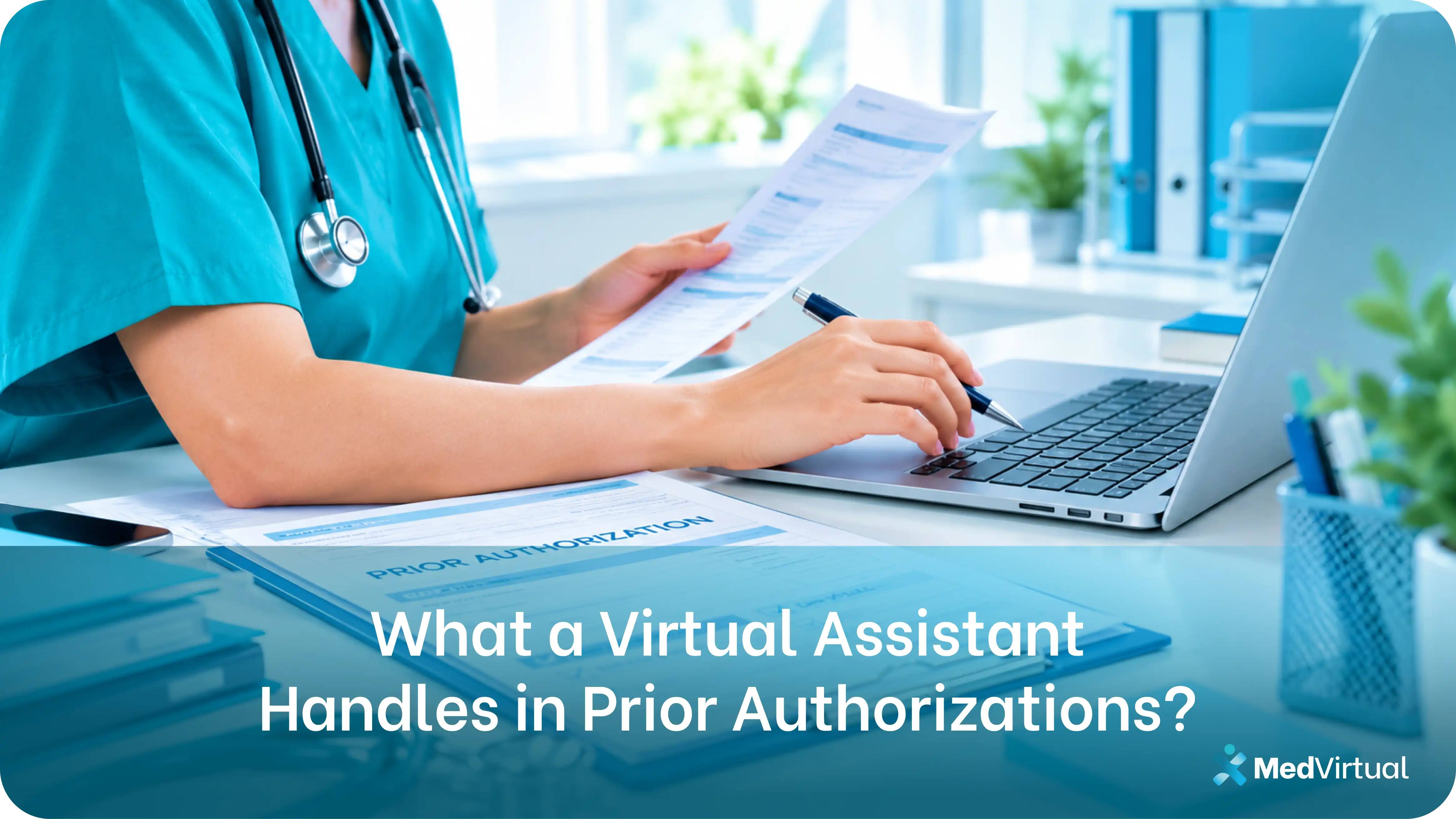
Can a virtual assistant handle prior authorizations? YES, and the workflow is more specific and more provable than the skepticism around it usually assumes.
Prior authorization has a reputation for being too payer-specific and too high-stakes to hand off to anyone outside the building. The actual workflow breaks down into clear, repeatable steps that a trained virtual assistant handles every day, without touching the clinical decisions that have to stay with your providers.
This post walks through exactly what a MedVirtual prior authorization virtual assistant does step by step, what stays with your in-house team, and where the line between the two actually sits.
Key Takeaways
- Prior authorization consumes an average of 13 hours of physician and staff time per week, according to the AMA's most recent physician survey.
- A trained virtual assistant handles the full administrative cycle: initiating requests, following up with payers, tracking timelines, and managing denials.
- Clinical judgment calls, physician-required peer-to-peer reviews, and final treatment decisions stay with your in-house team.
- The most effective model pairs a dedicated prior authorization virtual assistant with a medical billing virtual assistant, so authorization and claims submission stay coordinated.
What Does Prior Auth Actually Involve
Prior authorization requires a health plan's advance approval before a medical service or prescription qualifies for payment. In theory, it is a cost-control checkpoint.
In practice, it is one of the most time-consuming and error-prone administrative tasks in US healthcare.
According to the American Medical Association's most recent Prior Authorization Physician Survey, physicians complete an average of 39 to 40 prior authorization requests per week, consuming roughly 13 hours of physician and staff time in the process. Four in ten physicians report having staff whose job exists exclusively to handle prior authorization.
That last figure alone signals how much this workload has outgrown being a side task for whoever has a spare moment at the front desk.
That workload is not one task repeated 40 times. Each request involves confirming the specific payer's requirements, submitting clinical documentation in the format that payer expects, and tracking the request through an approval timeline that varies by plan.
A missed follow-up window can mean resubmitting the entire request from scratch, delaying patient care in the process.
The complexity compounds because no two payers run the same process. One plan might approve a request through an online portal within 48 hours.
Another might require a fax, a phone call, and a follow-up call a week later before anything moves. A staff member juggling prior authorization alongside phones, scheduling, and check-in cannot reasonably track a dozen different payer timelines with the consistency the process demands.
That inconsistency is where approvals get missed, not because the underlying clinical case was weak, but because nobody followed up on day nine of a ten-day window.
This is exactly the kind of workload that benefits from a dedicated, focused owner rather than being split across whoever on the front desk has a free ten minutes.
What a Virtual Assistant Handles Step by Step
A MedVirtual prior authorization virtual assistant owns the administrative cycle of a request from initiation through resolution.
1. Initiating the Request
Your virtual assistant confirms the specific payer's prior authorization requirements for the service or medication in question, then submits the request with the clinical documentation that payer requires. Requirements vary by plan, and a dedicated virtual assistant tracks those differences instead of relying on a generic template for every payer.
2. Following Up With Payers
Once a request is submitted, your virtual assistant follows up with the payer on a schedule tied to that plan's typical response window, rather than waiting for a denial to trigger action. Consistent follow-up is often the difference between an approval that arrives on time and one that lapses from inaction.
3. Tracking Approval Timelines
Every open request is tracked against its specific approval deadline. Your virtual assistant maintains visibility across every pending authorization at once, so nothing slips through simply because a different task took priority that day.
4. Handling Denials
When a request is denied, your virtual assistant reviews the denial reason, corrects documentation or coding errors where applicable, and resubmits or appeals according to that payer's process. Many denials stem from correctable documentation issues rather than genuine medical necessity disputes.
A dedicated virtual assistant catches those errors before they cost a patient another delay. A denial that sits unread for a week is a denial that becomes much harder to reverse.
5. Escalating Appropriately
When a denial requires clinical input, such as a peer-to-peer review or a case that needs the physician's direct judgment, your virtual assistant escalates it to the right person on your team with the documentation already organized. The escalation itself is fast because the groundwork is already done.
Your physician spends five minutes on a call instead of an hour tracking down the request history first.
What Stays With Your In-House Team
A prior authorization virtual assistant handles the administrative cycle. Certain parts of the process require your clinical team specifically, and a credible staffing partner should be direct about where that line sits.

Clinical judgment calls
Decisions about whether a specific treatment is medically necessary for a specific patient stay with your providers. A virtual assistant manages the paperwork around that judgment, not the judgment itself.
Peer-to-peer reviews
When a payer requires a physician-to-physician conversation to resolve a denial, that call has to happen between clinicians. Your virtual assistant prepares the documentation and schedules the call, but does not stand in for the physician on it.
Final treatment decisions
If an authorization is denied and the practice needs to decide whether to appeal, switch treatment approaches, or proceed without approval, that decision belongs to the provider and the patient, not the administrative team supporting it.
Complex, high-stakes appeals
Routine denials get corrected and resubmitted as part of the standard workflow. Appeals involving significant clinical complexity or legal exposure typically need direct physician and practice management involvement.
Being direct about this boundary is part of what makes the arrangement work. A staffing partner that claims to handle everything, including clinical decisions, is overpromising in a way that eventually creates risk for your practice.
The value of a dedicated prior authorization virtual assistant comes from owning the administrative cycle completely and reliably, not from blurring the line into clinical territory that should stay with your providers.
What the Virtual Assistant Handles vs What Stays In-House
Why This Pairs Well With Billing Support
Prior authorization and medical billing are connected workflows. A denied or delayed authorization often becomes a denied or delayed claim if the two are not tracked together.

Many practices pair a dedicated prior authorization virtual assistant with a dedicated medical billing virtual assistant, so an approved authorization flows directly into clean claim submission instead of getting lost in a handoff between disconnected systems.
When the same staffing partner places both roles, the two virtual assistants can coordinate directly, flagging an approved authorization the moment it clears so the billing side has everything it needs before the claim is even submitted. That handoff is where a lot of practices lose time today, not because either task is being done poorly, but because the person handling authorizations and the person handling claims are not talking to each other in real time.
Prior Auth Handled. Providers Freed Up.
Can a virtual assistant handle prior authorizations for a practice this busy? Yes, as long as there is a dedicated owner with the consistent bandwidth to track it, not a shared task split across whoever has a free moment.
MedVirtual has matched dedicated prior authorization virtual assistants into 250+ US practices, trained on the specific payer workflows those practices manage every day.
Every placement starts with confirming your top payers and your EMR before matching, not after.
Talk To Our Team to see how a dedicated prior authorization virtual assistant would fit your practice's payer mix.
Your Guide To Common Questions & Solutions