How Much a Medical Practice Saves Outsourcing Admin Work?

Every practice owner asks some version of the same question before adding staff: is this new hire actually worth what it will cost? So how much can a medical practice save outsourcing administrative work compared to hiring in-house?
The honest answer depends on your numbers, not a single flat percentage.
MedVirtual publishes a 70% average savings figure, and you have probably seen it on nearly every page of this site. What that number does not show you is how it actually gets calculated for a role like yours.
This post breaks down the real math, line by line, using typical figures for a small practice, so you can run the same calculation for your own numbers before making a staffing decision.
KEY TAKEAWAYS
- A full in-house admin hire costs far more than base salary once benefits, office space, equipment, and payroll taxes are added.
- Using typical small-practice figures, one in-house medical admin role runs about $5,100 per month, compared to roughly $1,600 per month for the equivalent role through MedVirtual.
- That gap works out to approximately 69% in this example, closely matching MedVirtual's published 70% average.
- Hidden costs like turnover, training ramp-up, and benefits administration rarely make it into the initial hiring budget, but they affect the real number.
What an In-House Admin Hire Actually Costs
Most practice owners budget for salary and stop there. The full cost of an in-house medical admin employee includes several line items that rarely show up until after the hire is made.
Using typical figures for a small practice hiring one full-time medical admin employee:
Base wages above reflect the median annual wage for Secretaries and Administrative Assistants in a medical specialty setting, per BLS Occupational Employment and Wage Statistics. Benefits, office space, and equipment figures are directional estimates for a typical small practice, not fixed costs, and will vary by region and role.
A practice in a high cost-of-living metro area should expect the wage line to run higher, while a smaller market may see it run lower.
MedVirtual vs In-House: How Much Can a Medical Practice Save Outsourcing Administrative Work?
Here is the same role priced through MedVirtual, using the published starting rate.
In this typical example, the monthly gap is about $3,500, or roughly 69% in savings. That lines up closely with MedVirtual's published 70% average cost savings versus in-house staffing, which is calculated the same way across many practices and roles.
A Worked Example: How Much Can a Medical Practice Save Outsourcing Administrative Work
Take a three-provider practice adding one full-time medical admin employee to handle scheduling, insurance verification, and EMR updates.
Hired in-house, using the typical figures above, that role costs approximately $61,194 per year once benefits, office space, and equipment are included.
The same role, filled through MedVirtual at a starting rate of $10 per hour for a full-time schedule, runs approximately $19,200 per year.
The difference: roughly $42,000 per year for one role, before factoring in recruiting costs, turnover risk, or the training time it takes a new in-house hire to reach full productivity.
The math compounds with every additional role. A practice adding both a medical admin and a medical biller in-house, using comparable BLS-based wage figures for a medical biller role, could be looking at a combined fully loaded cost well above $120,000 per year for two positions.
The same two roles filled through MedVirtual, at published starting rates, typically land in the $35,000 to $40,000 per year range combined. The percentage savings holds roughly steady whether you are staffing one role or building out a small virtual team, because the underlying cost structure, benefits, payroll taxes, office space, is proportional to headcount either way.
This is also why the savings percentage tends to be more meaningful as a planning tool than as a single fixed number. A practice in a lower cost-of-living region will see a smaller dollar gap than a practice in a major metro area, even if the percentage savings looks similar, because in-house wages vary regionally while MedVirtual's starting rate does not.
The Five (5) Hidden Costs Nobody Puts in the Budget
The math above only covers costs practices typically remember to budget for. Several real costs get left out of the initial calculation entirely.
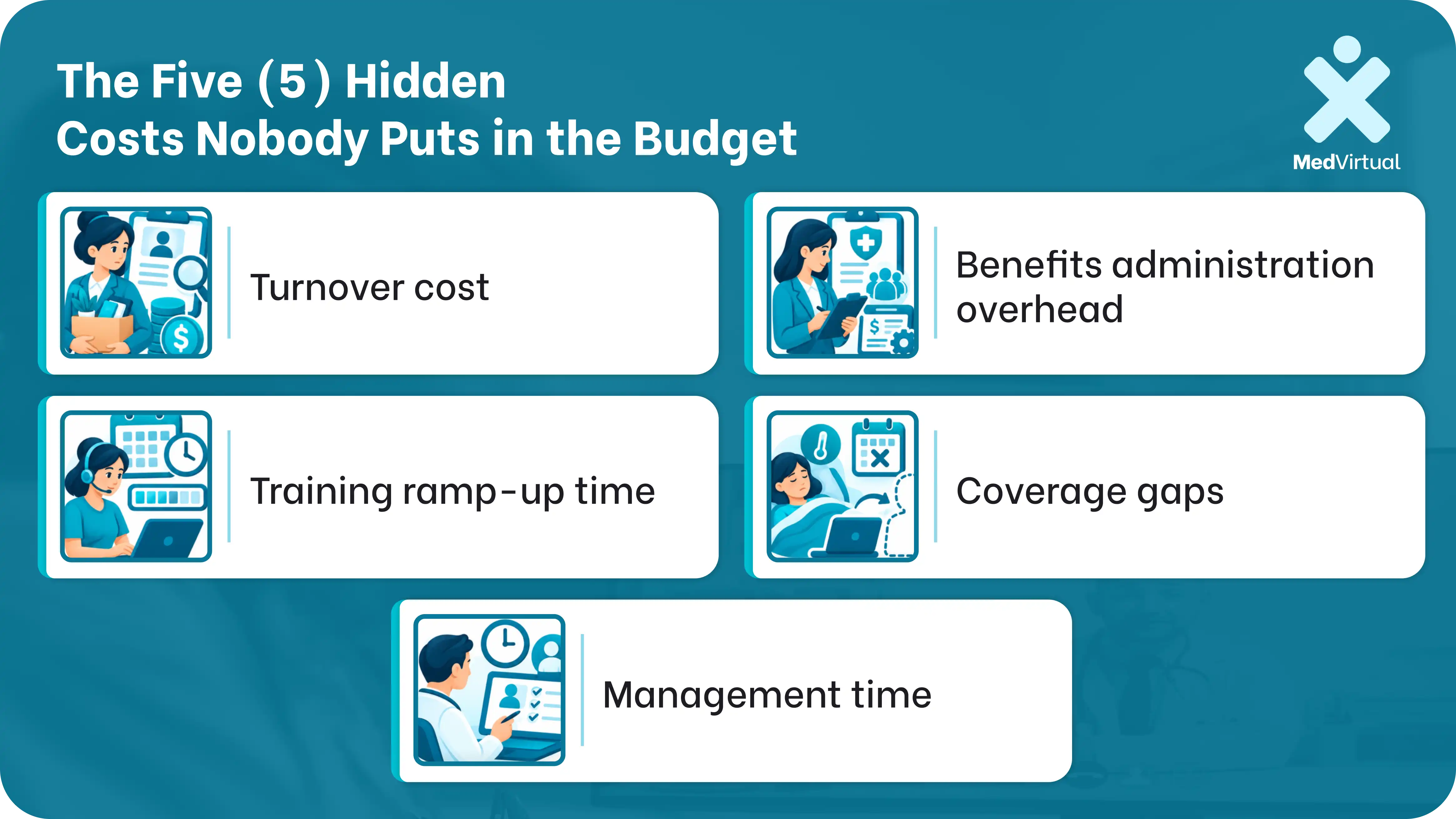
Turnover cost
When an in-house admin employee leaves, the practice absorbs the cost of posting the role, screening candidates, and running interviews again, on top of lost productivity while the seat sits empty. Industry examples commonly put recruiting and onboarding costs for a single administrative hire in the thousands of dollars, before that person has completed a single task.
That cost repeats every time the role turns over, and administrative roles in healthcare settings are not immune to turnover.
Training ramp-up time
A new in-house hire typically needs 60 to 90 days to reach full productivity, even with a good onboarding process. During that window, the practice is paying full wages for partial output, a cost that never appears as a line item but shows up in reduced throughput.
Benefits administration overhead
Someone at the practice has to manage enrollment, answer benefits questions, and handle payroll compliance for every in-house employee. That administrative time has a real cost, even when it is absorbed by an office manager instead of billed separately.
Coverage gaps
When an in-house employee is out sick, on vacation, or gives notice, the practice either goes without coverage or pays overtime to another staff member to fill the gap. A dedicated virtual assistant model does not eliminate this risk entirely, but it removes the recruiting cycle every time a gap needs to be filled.
Management time
Every in-house hire needs someone to supervise them, review their work, and handle performance issues when they come up. That management time is rarely priced into a hiring decision, but it is real time a practice manager or physician is not spending on patient care or growth activity.
A dedicated placement model shifts a meaningful share of that oversight to the staffing partner, through structured check-ins and performance tracking, rather than leaving it entirely on the practice's plate.
None of these hidden costs are unique to any one staffing model. They exist any time a practice adds headcount.
The difference is whether they get accounted for before the hiring decision is made or discovered afterward, when they are harder to plan around.
How to Run This Calculation for Your Own Practice
The example above uses typical figures for illustration. Your actual numbers will differ based on your region, the role you are hiring for, and your practice's current overhead.
To calculate your own savings:
- Add up the full loaded cost of the in-house role: base wages, benefits, payroll taxes, office space, and equipment.
- Compare that monthly total against the hourly rate for the equivalent virtual role.
- Factor in what you currently spend on recruiting and training for that position, since those costs disappear when the role is filled through a dedicated placement.
Most practice owners can pull base wages from a recent job posting or their own payroll records, and estimate benefits at roughly 25 to 35% of wages if they do not have an exact figure handy. Office space and equipment costs are usually the easiest to underestimate, since they get absorbed into general practice overhead instead of tracked per employee.
You do not need to estimate this by hand. MedVirtual's Cost Savings Calculator runs this exact comparison using your own numbers instead of typical figures, so the result reflects your actual practice rather than an illustrative example.
Run Your Own Numbers
The 70% average is a real number, but it is only useful once you see how it applies to your specific practice, your region, and the role you are trying to fill.
MedVirtual has helped 250+ US practices run this same calculation before making a staffing decision.

Run your own numbers, free. No email required.
Review our current pricing, or explore available virtual staffing roles.
Your Guide To Common Questions & Solutions