G2211 Billing Guide: When the Add-On Code Pays

G2211 is a Medicare add-on code that pays when it rides on a qualifying office, outpatient, home or residence E/M visit and you are the patient's continuing focal point for care. It denies when modifier 25 is on that E/M, unless the same-day service is a vaccine administration or a Medicare Part B preventive service.
This article breaks down what G2211 covers, which visits qualify, when the add-on code does not pay, the preventive and vaccine exception, a documentation checklist, and the top denial reasons. Rules and amounts are current as of October 10, 2026.
Key Takeaways
- The add-on needs a base code. The add-on rides on an eligible E/M base code on the same claim.
- The relationship decides payment. You must be the patient's continuing focal point for care or provide ongoing care for a single, serious or complex condition.
- Modifier 25 triggers a denial. The exception covers same-day vaccine administration, an annual wellness visit or another Medicare Part B preventive service.
- Home and residence visits qualify from 2026. CMS added them to the eligible base codes effective January 1, 2026.
What G2211 Covers in Plain English
G2211 is a HCPCS add-on code that pays for the extra work of a long-term care relationship. It recognizes the complexity inherent in visits where you manage a patient's care over time.
Add-on status
The code must sit on a base E/M code. Every G2211 line sits on a base E/M code.
Longitudinal care
CMS asks whether you are the continuing focal point for all of a patient's needed services. It also accepts ongoing care for a single, serious or complex condition.
No required diagnosis
CMS ties eligibility to the care relationship, with no required diagnosis list. It points to a continuous, active plan of care that needs specialized clinical direction, such as HIV or sickle cell disease.
Payment
Medicare has paid it separately since January 1, 2024. The 2026 national payment is about $17.37 in the office setting, before geographic adjustment, and the usual Part B deductible and coinsurance apply.
A visit with a discrete, routine or time-limited purpose generally does not qualify. CMS gives mole removal and fracture treatment as examples.
Which Visits Qualify for G2211
Qualification starts with the base code, so check the E/M family first. Choosing the right level for that E/M is covered in our CPT 99214 guide.
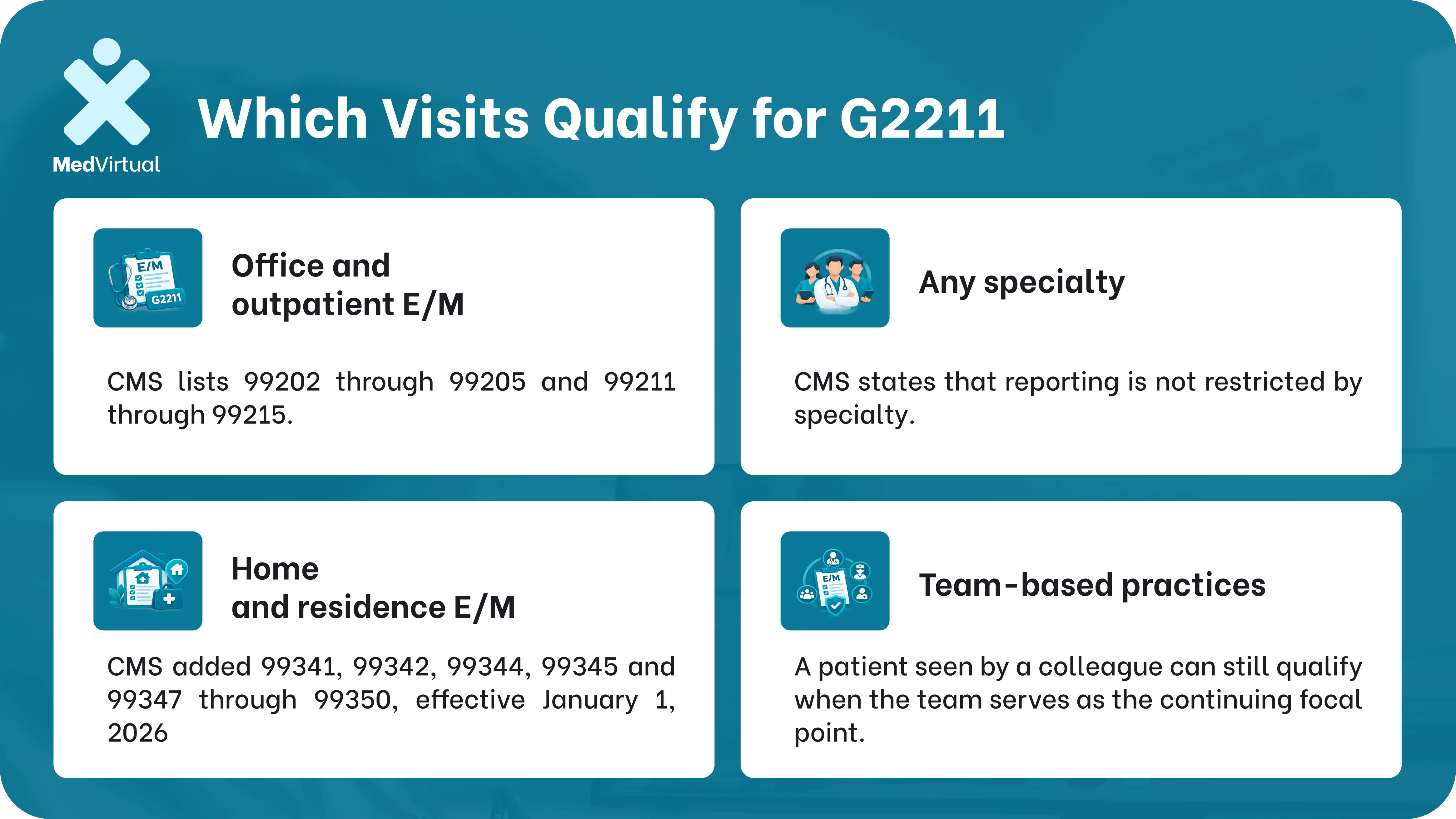
Office and outpatient E/M
CMS lists 99202 through 99205 and 99211 through 99215.
Home and residence E/M
CMS added 99341, 99342, 99344, 99345 and 99347 through 99350, effective January 1, 2026.
Any specialty
CMS states that reporting is not restricted by specialty.
Team-based practices
A patient seen by a colleague can still qualify when the team serves as the continuing focal point.
The code attaches only to office, outpatient, home, and residence E/M codes.
When G2211 Does Not Pay
The table below shows how common scenarios resolve.
Source: CMS HCPCS G2211 guidance (MM13473) and Transmittal 13753, as of October 10, 2026.
Modifier 25 with a procedure
CMS denies payment when the add-on is reported with an eligible E/M that carries modifier 25 on the same date, for the same patient, by the same practitioner. Our modifier 25 exception post explains modifier 25 documentation.
No ongoing relationship
A single visit for an acute concern, with no plan to take on ongoing care, fails the focal-point test.
FQHCs and RHCs
These clinics receive encounter-based rates, so the add-on is bundled and receives no separate payment.
The Preventive and Vaccine Exception
Since January 1, 2025, Medicare can pay the add-on on an E/M with modifier 25 when specific same-day services are present. The exception covers an annual wellness visit, vaccine administration and any Medicare Part B preventive service.
What qualifies
The qualifying service must appear on the same date as the E/M, such as an annual wellness visit or flu shot administration. Our flu shot coding guide shows how the vaccine administration code is reported.
Home and residence visits
The same exception applies to home and residence E/M visits from January 1, 2026, per Transmittal 13753.
Eligible code list
CMS maintains a list of eligible preventive and vaccine administration codes in the attachment to Transmittal 13199, the current version of this policy (this transmittal rescinded and replaced the original Transmittal 13015 to add an updated attachment; MM13473 covers the underlying guidance). Check your code against that list before you rely on the exception.
The E/M itself must still be medically necessary and separately identifiable from the preventive service.
What May Change in 2027
CMS's proposed CY 2027 Physician Fee Schedule rule would restructure G2211 entirely: instead of a flat add-on payment, the code would become a modifier appended directly to the base E/M code, increasing that visit's payment by 16% (or 32% for practitioners participating in certain Accountable Care Organization models).
Nothing changes for 2026 billing, but practices should watch this proposal before the final rule is issued. See the CY 2027 PFS proposed rule fact sheet for the full detail.
G2211 Documentation Checklist
CMS has not specified additional documentation requirements for this code. Medicare reviewers can use the record to confirm medical necessity and the care relationship.
Work through this checklist on each visit.
Confirm the base code
Verify the E/M code is an eligible office, outpatient, home or residence code.
Document medical necessity
Record the reason for the E/M visit and the patient's problem.
Show the care relationship
State that you are the continuing focal point for the patient's care or that you manage a serious or complex condition over time.
Record the plan
Document your assessment, plan of care and any follow-up or coordination with other clinicians.
Make it patient-specific
Replace generic phrases such as "patient is complex" with details unique to the patient.
Check modifier 25
If modifier 25 is on the E/M, confirm a vaccine, wellness or preventive service appears on the same date.
Check the setting
Confirm the visit is not an FQHC, RHC, inpatient, ED or nursing facility encounter.
Top G2211 Denial Reasons and Mistakes to Avoid
Most denials trace back to a short list of repeat errors. Catch these before the claim leaves your office.
Modifier 25 with a procedure
The E/M carries modifier 25 and the only same-day service is a procedure. The add-on denies.
Ineligible base code
The practice adds the add-on to an inpatient, ED or nursing facility visit. These are not eligible base codes.
Missing base code
The add-on is submitted without a qualifying E/M on the claim.
One-time visits
The note shows a single acute visit with no ongoing care responsibility.
FQHC or RHC billing
Clinics paid an encounter rate add the code and receive no separate payment.
Home visit billed before the 2026 policy
The add-on on a home or residence code with a date of service before January 1, 2026 falls outside the policy.
Skipped payer check
The practice assumes every payer follows Medicare's rule.
Troubleshooting a Denied Add-On Claim
Start with the remittance, since it names the reason. A methodical review resolves most denials.
Read the denial codes
A G2211 denial for the modifier 25 conflict is reported under Group Code CO with Claim Adjustment Reason Code (CARC) 234, "This procedure is not paid separately," per Transmittal R12424CP, which superseded the original edit transmittal. CARC 234 requires an accompanying remark code on the remittance; confirm the specific remark code shown on your own remittance advice rather than assuming a fixed one, since CMS does not specify a single required RARC for this denial in its published guidance.
Check the E/M
Confirm the base code is eligible and look for modifier 25.
Check the same-day services
Look for a vaccine, wellness visit or preventive service that triggers the exception.
Review the note
Confirm it supports the focal-point relationship.
Correct and resubmit
Fix the single error you found and resubmit within the payer's filing window.
Commercial Payer Variation
Commercial plans, Medicare Advantage plans and Medicaid are not required to follow Medicare's policy. Each can set its own coverage and payment rules.
Contract review
Read your payer contracts and provider bulletins for add-on code language.
Ask provider relations
Confirm whether the payer pays the code, which base codes it accepts and how it treats modifier 25.
Build payer rules
Keep a one-page reference per payer so your billing owner applies the right edit on every claim.
Why G2211 Claims Need a Billing Owner
G2211 pays about $17.37 in the office setting, before geographic adjustment. Small rule differences by payer, modifier and setting add up across hundreds of claims.
A dedicated billing virtual assistant can apply the checklist on each claim before submission. MedVirtual places HIPAA-trained medical billing virtual assistants who start in under 2 weeks and work inside your existing systems.
Bill G2211 Correctly Every Time
Clean billing comes down to two checks: confirm the longitudinal care relationship in the note, and confirm the modifier 25 exception before you submit. Your billing owner can then spend time on real exceptions instead of rework.
MedVirtual includes billing support matched to your specialty and payer mix, with 100% HIPAA-trained virtual assistants and 70% cost savings vs in-house staffing.

Your Guide To Common Questions & Solutions