Flu Shot CPT Code Guide: Medicare vs Commercial Billing

Every flu shot CPT code decision starts with one split: the vaccine product code and the administration code are billed separately. Medicare pays administration under G0008 with diagnosis Z23, while commercial payers typically expect 90471 for the first vaccine and 90472 for each additional one.
This article breaks down the two parts of every flu claim, how Medicare and commercial billing differ, when modifier 25 applies, a numbered billing checklist, and the denials that slow payment. Product codes and payment amounts are current as of October 13, 2026.
Key Takeaways
- Two codes per claim. Every flu claim pairs a vaccine product code (such as 90662) with an administration code (such as G0008).
- Medicare uses G0008. Report G0008 for administration and Z23 as the diagnosis on Medicare Part B flu claims.
- Commercial payers use 90471 and 90472. Report 90471 for the first vaccine and 90472 for each additional vaccine, then confirm payer rules.
- Season dates matter. The 2026-2027 season runs August 1, 2026 to July 31, 2027, and each product code carries its own effective date.
The Two Parts of Every Flu Claim
A flu claim has a product half and a service half. The product half identifies what was in the syringe, and the service half identifies the work of giving it.
Vaccine product code
This code names the vaccine, its formulation and its age group. Payers use it to price the drug.
Administration code
This code pays for the injection, the documentation and the staff time. Medicare uses G0008, and most commercial payers use 90471 or 90472.
Claims fall apart when a practice bills only one half or swaps the halves between payers. A vaccine-only claim pays for the drug and leaves the injection unpaid.
Medicare prices most Part B vaccines, including seasonal flu vaccines, at 95% of the Average Wholesale Price (AWP), with payment limits established annually. See the 2026-2027 annual update transmittal for the full methodology.
The table below lists the 2026-2027 Medicare product codes and national payment allowances.
Source: CMS Part B vaccine pricing, 2026-2027 season, as of October 10, 2026. Code 90616 is effective August 5, 2026 and code 90660 is effective August 24, 2026. All other codes are effective August 1, 2026.
All 2026-2027 U.S. flu vaccines are trivalent. Afluria is discontinued for the 2026-2027 season, so remove it from your charge master.
Flu Shot CPT Code for Medicare: G0008 and Z23
Medicare Part B covers the seasonal flu shot, and patients pay nothing when the provider accepts assignment. Part B waives the deductible and coinsurance.
Administration code
Bill G0008 for administration on every Medicare flu claim. G0008 is the only administration code Medicare recognizes for flu shots.
Diagnosis code
Report Z23 (encounter for immunization). The CMS Claims Processing Manual requires it on flu vaccine claims.
Payment rate
The 2026 national G0008 payment rate is $34.62 before geographic adjustment. See CMS vaccine pricing for the full geographically-adjusted rate file.
Roster billing
Roster billing is allowed for flu shots given to groups of patients, such as at a clinic or community event.
Coverage limits
Patients can receive a flu shot twice in one calendar year when the shots fall in two different flu seasons. Additional shots in the same season are covered when medically necessary.
For a visit that includes only the flu shot, bill the product code and G0008 without an office visit. The manual states that a provider seen only to give the vaccine may not routinely bill an E/M visit.
Flu Shot CPT Code for Commercial Payers: 90471 and 90472
Most commercial payers follow CPT immunization administration codes instead of G0008. The same product code rules apply, and the administration code changes.
First vaccine
Report 90471 for the first vaccine given by injection. Our CPT 90471 guide covers documentation requirements in full.
Additional vaccines
Report 90472 for each additional vaccine injection at the same visit. Code 90472 is an add-on code and cannot be billed alone.
Intranasal vaccine
FluMist (90660) is given by the intranasal route, which uses 90473 for the first vaccine and 90474 for each additional one.
Patients through age 18
Many payers expect 90460 and 90461 when the provider counsels the patient or caregiver. Confirm each payer's policy before billing.
Only one first-order administration code belongs to an encounter. Payer policies vary, so check each contract before you build a charge template.
Medicare vs Commercial: Side-by-Side Comparison
Same-Day E/M Visits and Modifier 25
A patient may arrive for a flu shot and also need a separately documented problem. In that case, a significant and separately identifiable E/M service can be billed alongside the vaccine.
When modifier 25 applies
Append modifier 25 to the E/M code when the visit includes work beyond the vaccine decision and administration. The note must show that work clearly.
When it does not apply
A routine pre-vaccine check is already included in the administration code. Our post on modifier 25 explains the documentation test in detail.
Medicare and commercial payers both review modifier 25 claims closely, so a clean note protects the payment.
How to Bill a Flu Shot: 7 Steps
Work through the same seven steps on every claim. Each step is one action.
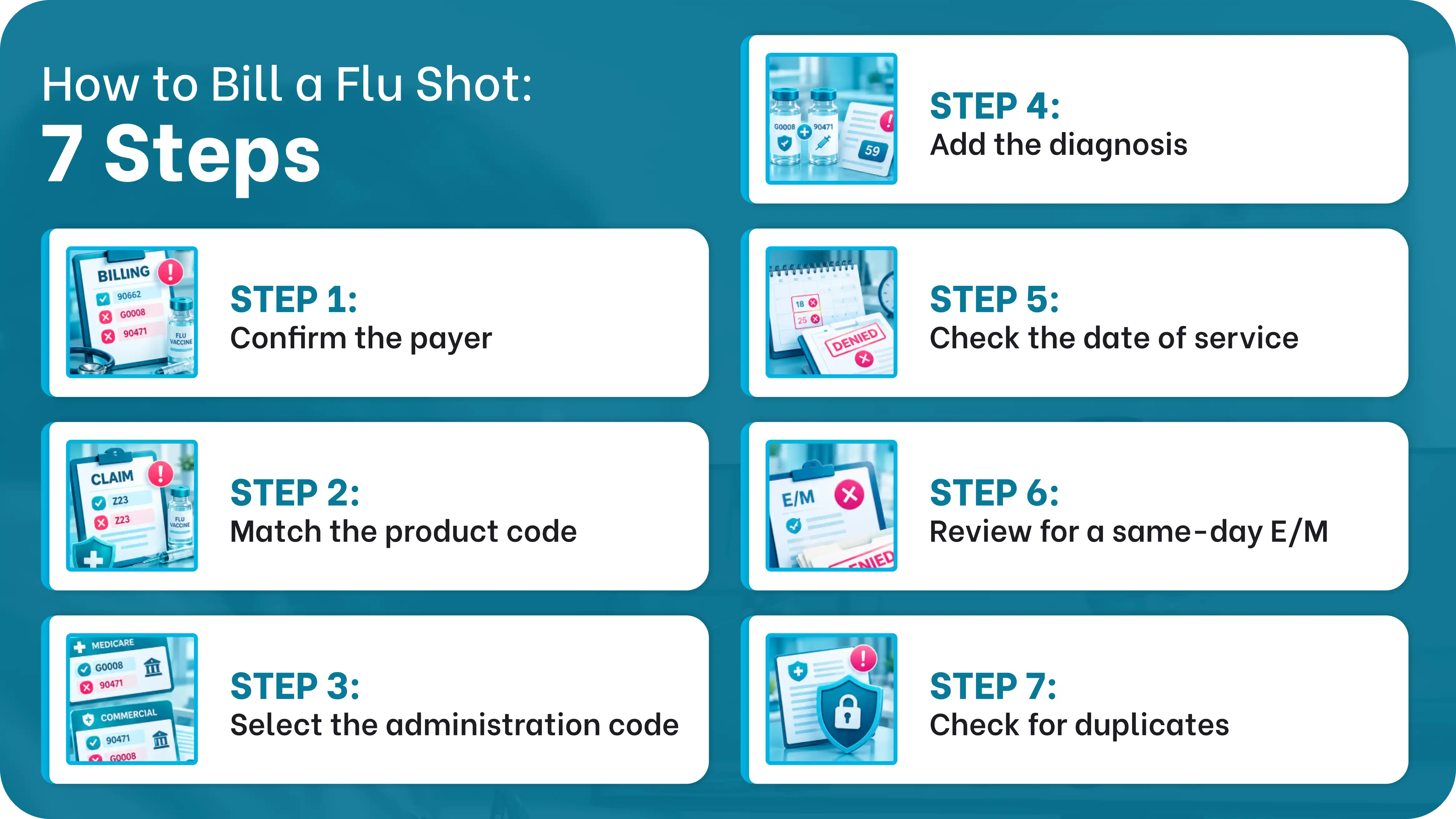
- Confirm the payer. Check whether the patient has Medicare Part B or a commercial plan before you pick any code.
- Match the product code. Find the vaccine on the label and select its code from the current-season table above.
- Select the administration code. Use G0008 for Medicare, or 90471 for the first vaccine and 90472 for each additional vaccine on commercial claims.
- Add the diagnosis. Enter Z23 on the claim.
- Check the date of service. Confirm the date falls on or after the product code's effective date.
- Review for a same-day E/M. Append modifier 25 only when the note supports a separate service.
- Check for duplicates. Search for an existing claim with the same patient, date of service and code before you submit.
Common Flu Shot CPT Code Denials and Mistakes to Avoid
Most flu denials trace back to a small set of repeat errors. These are the patterns to catch before a claim leaves your office.
Missing administration code
The practice bills the product code and forgets G0008, 90471 or 90472. The vaccine is paid and the work goes unpaid.
Missing Z23
Medicare requires Z23 on flu claims, and a missing or wrong diagnosis triggers a rejection.
Wrong administration code for the payer
Billing 90471 to Medicare or G0008 to a commercial payer is a frequent mix-up. Build payer-specific charge templates to prevent it.
Duplicate claims
Medicare edits reject a second same-day claim with the same patient ID, date of service and code. The denial uses CARC 18.
Date of service before the effective date
Code 90616 starts August 5, 2026 and code 90660 starts August 24, 2026. Claims dated before the effective date are denied.
Mixed vaccines on one visit
Some payers deny G0008 and 90471 billed together for a flu vaccine plus a non-flu vaccine. Modifier 59 may be needed, so confirm the payer's rule.
Unneeded office visit
Billing an E/M for a vaccine-only visit invites a denial or a recoupment.
Troubleshooting a Denied Flu Claim
A denial gives you a code and a reason, so start there. See our guide to denial management for the full appeal process.
- Read the denial codes. Note the CARC and any remark code on the remittance.
- Compare the claim to the payer. Check that the administration code, product code and Z23 match what that payer expects.
- Check for a prior claim. A CARC 18 denial means a matching claim already exists, so review its status before you resubmit.
- Correct and resubmit. Fix the one error you found and send the claim inside the payer's filing window.
Why Flu Season Claim Volume Needs a Dedicated Owner
The flu season runs August 1 to July 31, and each new vaccine product adds codes and effective dates to track. Your front desk handles that extra volume while also checking in patients and answering phones.
A dedicated billing virtual assistant can own flu claims from charge entry to payment posting. MedVirtual places HIPAA-trained medical billing virtual assistants who start in under 2 weeks and work inside your existing systems.
Clean Flu Shot CPT Code Claims
A clean flu billing process comes down to two habits: pair the right product code with the right administration code, and set payer-specific templates before the season peaks. Your billing owner then spends the busy weeks on exceptions instead of rework.

MedVirtual includes billing support matched to your specialty and payer mix, with 100% HIPAA-trained virtual assistants and 70% cost savings compared to an in-house hire.
Your Guide To Common Questions & Solutions