Medical Practice Growth: The Role of Virtual Staff

A practice can have the right clinical reputation, the right location, and the right patient experience, and still not achieve medical practice growth. The reason is almost always operational. The front desk is backlogged. Billing follow-up is running two weeks behind. Marketing campaigns never get executed. Patient recall calls are not happening.
Medical practice growth is not just about attracting new patients. It is about building the operational capacity to handle more of them, retain the ones you have, and run the revenue cycle efficiently enough to make growth profitable rather than just busy.
That operational capacity starts with staffing. And for most private practices, the staffing model that makes sustainable growth possible is not the one they are currently using.
Key Takeaways
- Medical practice growth depends as much on operational capacity as on clinical reputation. A practice without adequate admin, billing, and marketing support cannot scale effectively regardless of patient demand.
- The most common growth bottlenecks in private practices are front-office overload, billing delays, inconsistent patient follow-up, and underfunded marketing, all of which are administrative problems, not clinical ones.
- Virtual assistants provide dedicated, HIPAA-trained administrative support across every function that enables practice growth, at a fraction of the cost of equivalent in-house hires.
- Practices that delegate admin, billing, and marketing execution to remote virtual assistants free their clinical team to focus on patient care and their leadership team to focus on strategy.
What Medical Practice Growth Actually Requires
Most conversations about growing a medical practice focus on three areas: patient acquisition, patient retention, and revenue optimization. Those are the outcomes. The inputs that determine whether a practice can actually achieve them are operational.
A practice grows when it can schedule and see more patients without degrading the experience for the ones already in the system. That requires consistent scheduling, reliable follow-up, and a front desk that is not at capacity on a normal day.
A practice grows its revenue when billing is accurate, claims are submitted on time, and denials are followed up before they age out. That requires a dedicated billing function that is not split between three other jobs.
A practice grows its patient base when it stays visible, communicates consistently with existing patients, and builds referral relationships with other providers. That requires consistent marketing activity that most clinical teams do not have time to execute.
All three of these growth drivers are administrative functions. And in most private practices, they are handled by in-house staff who are already at full capacity managing the baseline workload.
The Five (5) Operational Pillars of Medical Practice Growth
Understanding where admin staffing directly enables or blocks growth requires looking at each function separately.
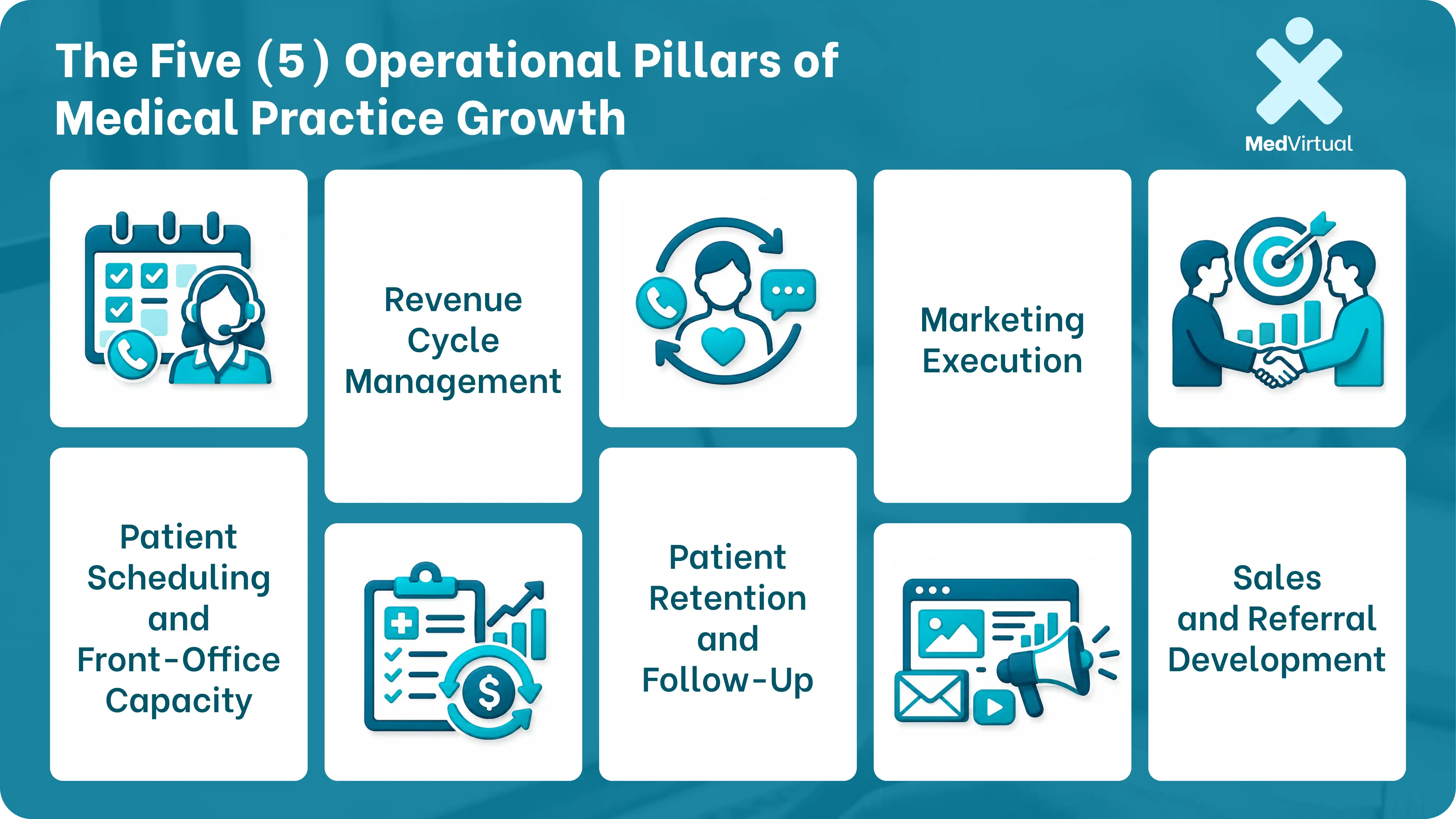
Patient Scheduling and Front-Office Capacity
The front desk is the first and last point of contact for every patient. When it is understaffed or overwhelmed, scheduling accuracy drops, call wait times increase, and patient experience degrades before a patient ever sees a provider.
A virtual medical receptionist or medical admin virtual assistant handles inbound calls, appointment scheduling, confirmations, and reschedules with the same capability as an in-house hire. Without the overhead.
Revenue Cycle Management
A practice that cannot collect what it bills cannot fund growth. Insurance verification errors, delayed claim submission, and uncollected denials are the most common causes of revenue cycle underperformance in private practices.
A dedicated medical billing virtual assistant runs eligibility verification before every appointment, submits clean claims, and works denials before the window closes. Revenue stays in the cycle instead of walking out the door.
Patient Retention and Follow-Up
Patient retention is a growth strategy. Keeping an existing patient is significantly less expensive than acquiring a new one. But retention requires consistent outreach: recall reminders, follow-up calls, portal message responses, and care plan tracking between appointments.
A medical admin or virtual patient care coordinator manages the full patient follow-up cycle. Patients stay engaged with the practice between appointments because someone is accountable for the outreach.
Marketing Execution
Patient acquisition requires consistent visibility. That means active social media channels, regular email outreach to existing patients and referral partners, and content distribution that keeps the practice top of mind.
A healthcare marketing virtual assistant manages the content calendar, schedules posts, runs email campaigns, and maintains CRM records. The strategy exists. The virtual assistant makes sure it actually gets executed every week.
Sales and Referral Development
For practices that depend on referral volume or operate in a cash-pay or concierge model, active outreach to referring providers and potential patients is a direct growth input. Most practices do not have anyone dedicated to this function.
A healthcare sales virtual assistant manages outbound prospecting, books consultations, and maintains CRM accuracy. New patient pipeline stays active without pulling clinical staff away from care.
Where Practices Stall: The Admin Bottleneck
The most common pattern in practices that are not growing is not a lack of demand. It is a capacity ceiling imposed by admin infrastructure that cannot support more volume.
When the front desk is at full capacity, every new patient is a strain rather than a win. Scheduling errors increase. Existing patients notice degraded responsiveness. Staff burnout accelerates, and turnover follows.
When billing is running behind, collections lag. A practice treating more patients but collecting the same revenue is not growing. It is working harder for the same result.
When marketing never gets executed consistently because the clinical and admin team does not have time, patient acquisition stalls and the practice depends entirely on word of mouth and referral patterns it has no control over.
Each of these is a staffing problem with a staffing solution.
How Virtual Assistants Enable Medical Practice Growth
The virtual assistant model solves the admin bottleneck by adding dedicated, full-time capacity to each growth-critical function without the overhead of an in-house hire.

MedVirtual places dedicated virtual assistants who work exclusively for your practice, pre-matched to your EMR and specialty workflows, HIPAA-trained before day one. The practice gets the full-time coverage of an in-house hire at a fraction of the fully-loaded cost.
Across the five operational pillars:
A medical admin virtual assistant keeps scheduling current, confirms appointments, handles recalls, and manages front-office communications. The front desk stops being the bottleneck.
A medical billing virtual assistant runs clean claim submission, follows up on denials, and tracks aging receivables. Revenue cycle performance improves without adding headcount.
A virtual patient care coordinator manages referral tracking, prior authorization, and care transition documentation. Complex cases move through the practice without falling between providers.
A healthcare marketing virtual assistant executes the content calendar, manages social media, runs email campaigns, and updates CRM records. The practice stays visible every week regardless of how busy the clinical team is.
A healthcare sales virtual assistant manages outbound outreach, qualifies leads, and books consultations. The new patient pipeline stays active.
Each role supports a different growth driver. Together, they give a practice the operational foundation to actually execute on a growth strategy rather than talk about one.
What to Look for in a Virtual Staffing Partner for a Growing Practice
Not every virtual assistant model delivers the same outcome. Practices evaluating virtual staffing for growth should verify:
Dedicated placement, not a shared pool. A virtual assistant who works only for your practice develops the institutional knowledge your workflows require. A shared or rotating model does not.
HIPAA training and compliance documentation. Any virtual assistant who touches patient data must have completed mandatory training before they start and be covered under a signed Business Associate Agreement.
EMR pre-matching. The virtual assistant should arrive with hands-on experience in the specific EMR your practice uses, not require a training period at your expense.
Role-specific experience. A marketing virtual assistant and a billing virtual assistant are not interchangeable. The staffing partner should match candidates to the specific function you need covered.
Structured onboarding and performance oversight. A practice adding admin capacity for growth needs assurance that the virtual assistant will be fully integrated and productive within days, not months.
Virtual Staffing Is the Infrastructure Your Growth Strategy Needs
Medical practice growth stalls when operational capacity cannot keep up with clinical demand. Virtual assistants close that gap by adding dedicated, HIPAA-trained support across every function that enables growth, from the front desk to billing to marketing to patient follow-up.
Book a Consultation with MedVirtual to discuss which roles your practice needs to build the operational foundation for sustainable growth. Or read 12 Essential Strategies for Growing a Medical Practice Successfully for a broader look at the growth strategies virtual staffing supports.
Your Guide To Common Questions & Solutions