HIPAA Compliant AI Receptionist: What to Check First
A vendor can call its AI receptionist HIPAA compliant in one line of marketing copy. A HIPAA compliant AI receptionist is one whose vendor signs a business associate agreement (BAA) and can show how it protects patient data, so verify the BAA, how recordings are handled, and how a call reaches a human.
This checklist covers six things to settle before you buy, where AI struggles on patient calls, and how AI and a human receptionist compare. It also lists questions for any vendor and explains when a trained human is the better fit, and stays neutral on specific vendors.
Key Takeaways
- No agency certifies AI receptionists. HHS does not endorse private HIPAA certifications, so the signed BAA and documented safeguards are the proof.
- A vendor that holds patient data is a business associate. HHS says this applies even when the vendor cannot read the data.
- Recordings and transcripts create new patient data. Settle storage, retention, access, and deletion before you go live.
- A human path is a trust requirement. In a 2026 Salesforce survey, 89% of patients said a clear route to a person is essential for trusting AI administrative support.
What Makes a HIPAA Compliant AI Receptionist
HIPAA compliance comes from a signed BAA, safeguards that protect patient information, and a practice that verifies both before go-live.
HHS does not endorse or recognize private organizations' HIPAA certifications, so a certified badge proves little. HHS cloud-computing guidance also states that a vendor maintaining patient data is a business associate even when it cannot view the data, and that a practice using one without a BAA is in violation.
The HIPAA Compliant AI Receptionist Checklist
Settle these six items in writing before any patient call reaches the system.
A Signed BAA, Including Subcontractors
Ask for the agreement itself before any patient data flows. Also ask which subcontractors process your calls, such as speech recognition, language models, telephony, and storage, and whether each is covered by its own BAA.
How PHI Is Handled
Ask how data is encrypted in transit and at rest, and whether patient details are used to train or improve the vendor's models. Get the answer in writing, because marketing pages rarely cover it.
Call Recordings and Transcripts
Recordings and transcripts that identify a patient and relate to care are generally treated as protected health information. Ask where they are stored, how long they are kept, who can listen, and how they are deleted, and confirm call-recording consent rules for your state with your counsel.
Access and Audit Trails
Ask who at the vendor can open your patient data, and whether access is role-based, protected by multi-factor authentication, and logged. You should be able to request those logs.
Escalation to a Human
Define which calls go to a person: distress, urgent symptoms, billing disputes, and anything outside the script. Confirm the handoff is immediate and that the person sees the full call context.
Accountability
Ask who answers when something goes wrong, and what the contract says about incident response. Your practice remains responsible for having the BAA in place, so a named contact and clear commitments matter.
Where AI Struggles on Patient Calls
AI performs well on routine, rule-based calls. It struggles where callers step outside the script.
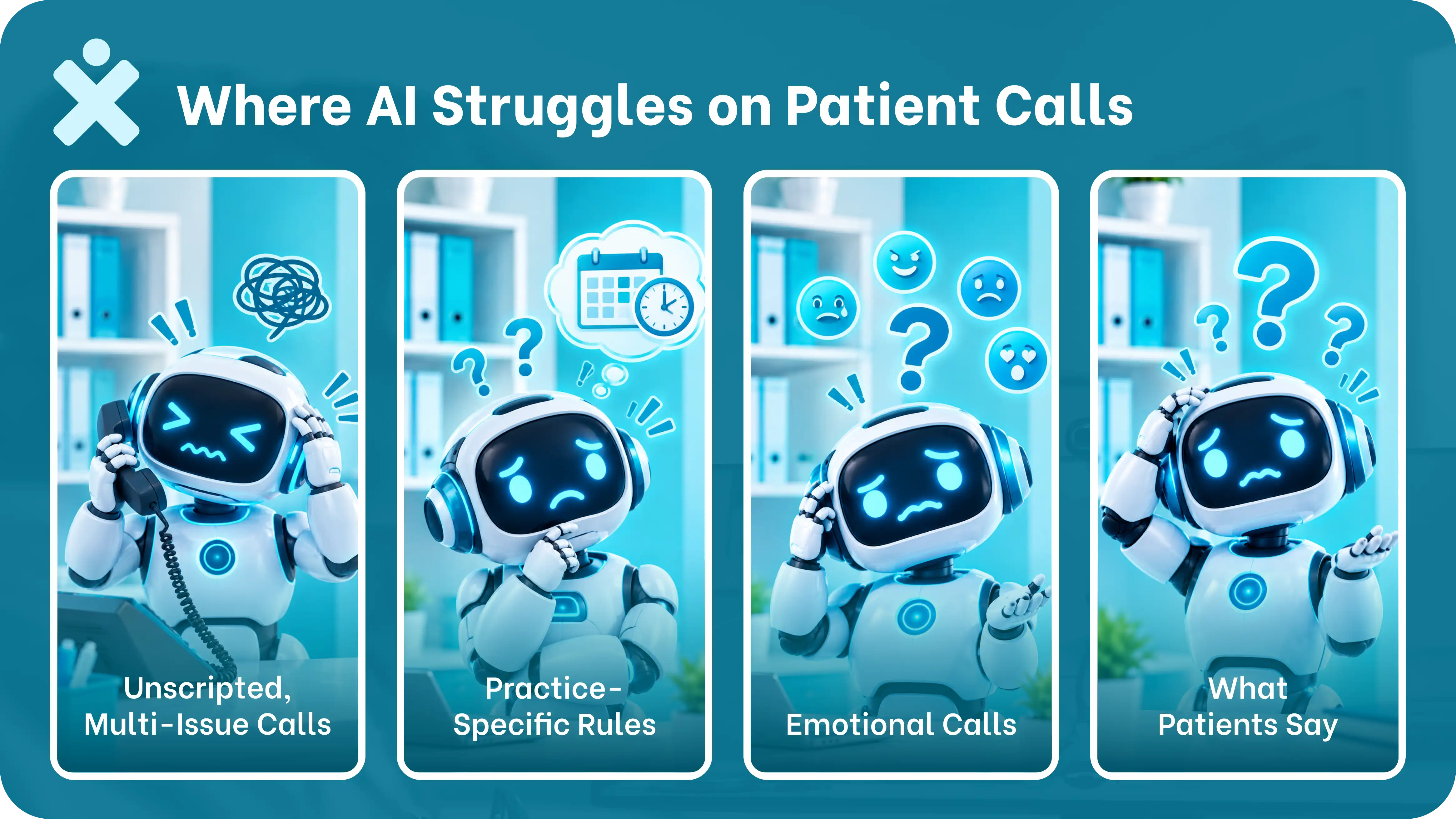
Unscripted, Multi-Issue Calls
Patients often call with several requests at once. A caller may mention a swollen knee, a refill, and a billing question in one breath, and rule-based flows route one branch at a time.
Practice-Specific Rules
Every practice has rules a vendor demo never captures, such as provider preferences, prior authorization steps, and longer slots for patients with mobility needs. When those rules are unwritten, the system misbooks and your staff fixes it.
Emotional Calls
A frightened or frustrated caller needs a response beyond a menu. When a system reaches the edge of its script, the handoff is the only thing standing between that caller and a dead end.
What Patients Say
In a June 2026 OnePoll survey of 6,000 consumers across the US, UK, and Canada, commissioned by WellReceived, 90% preferred talking to a real person instead of AI when contacting a healthcare practice. The same survey found that 82% had actively asked for a human instead of continuing with an AI agent.
A 2026 Salesforce Connected Health Consumer Report, which surveyed more than 3,200 patients across 8 countries, found that 89% say a clear option to escalate to a human is essential for trusting AI-based administrative support.
AI Receptionist vs Human Receptionist
The two differ on several points that matter during vetting. This table compares them on the points that matter during vetting.
Questions to Ask Any Vendor
Bring these to every demo. A good answer is specific and in writing.
Go Deeper: The Beyond the Hype Webinar
MedVirtual's Beyond the Hype webinar covers where AI helps in the back office and where it falls short on the patient frontline. See News and Events for the latest session.
When a Human Receptionist Is the Better Fit
A trained human is usually the better fit when callers are unscripted, anxious, or dealing with sensitive issues, as in mental health, pediatrics, and oncology. It is also the better fit when your scheduling rules are complex and you want one named person accountable for the front desk.

MedVirtual places dedicated, HIPAA-trained virtual receptionists who work only for your practice. See the Virtual Medical Receptionist page for the role in detail.
To compare all four front-desk models, see our guide to choosing a virtual receptionist for doctors. For HIPAA questions about human receptionists, read our post on a HIPAA-compliant virtual receptionist, and for how AI and people divide the work, see our page on human virtual assistants vs AI.
Choosing a HIPAA Compliant AI Receptionist
Choosing a HIPAA compliant AI receptionist starts with the BAA and ends with a clear path to a person. Settle the six checklist items in writing, and keep a trained human on the calls AI cannot handle.
Book a Consultation to talk through the right front-desk model for your practice.
Your Guide To Common Questions & Solutions