HIPAA Virtual Receptionist: What Practices Must Know

A HIPAA virtual receptionist who handles patient calls, schedules appointments, and manages portal messages is touching Protected Health Information on every interaction. That makes HIPAA compliance not a feature to look for but a legal requirement for every practice that uses one.
Most practices evaluating virtual receptionist vendors need a clear picture of what HIPAA compliance actually requires before they can verify a vendor meets it. A checkbox on a vendor's website requires verification, what matters is whether the person handling your patient calls has documented training, a signed BAA, and encrypted access controls in place.
This guide breaks down what a HIPAA compliant virtual receptionist actually is, what the compliance requirements are, and what your practice must verify before a virtual receptionist touches a single patient record.
Key Takeaways
- A HIPAA compliant virtual receptionist handles patient calls, scheduling, and PHI under a signed Business Associate Agreement with documented HIPAA training completed before placement.
- "HIPAA compliant" is not self-certifying. Every vendor that touches PHI must be verified against specific technical, administrative, and physical safeguard requirements.
- The human vs AI distinction matters for HIPAA compliance. AI virtual receptionists introduce data sovereignty and model training risks that dedicated human receptionists do not.
- A dedicated, HIPAA-trained human virtual receptionist integrated into your EMR provides the most consistent compliance outcome for private medical practices.
What Is a HIPAA virtual receptionist?
A HIPAA virtual receptionist is a remote professional who manages patient-facing communications, including inbound calls, appointment scheduling, portal messages, and intake coordination, under the full set of HIPAA technical, administrative, and physical safeguards required when handling Protected Health Information.
The key word is "under." A virtual receptionist is HIPAA compliant not because of the product category they belong to, but because of the controls in place around how they access, handle, and transmit patient data.
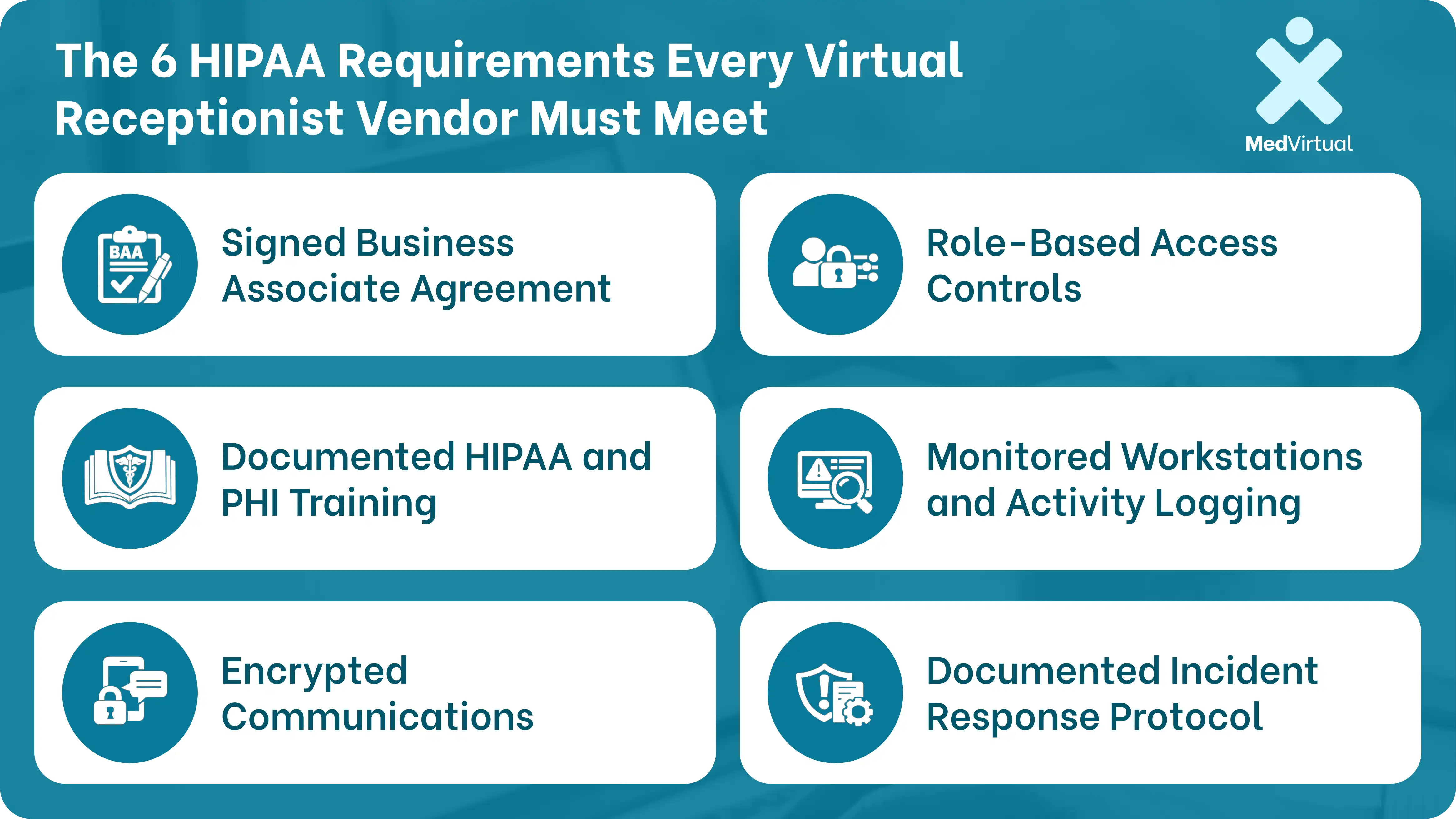
Those controls include a signed Business Associate Agreement with your practice, documented HIPAA and PHI training before accessing any patient data, encrypted communication channels, role-based access controls that limit what data they can see, monitored workstations, activity logging, and documented incident response protocols.
Any virtual receptionist service that cannot demonstrate each of these controls is not HIPAA compliant regardless of how it describes itself.
Why HIPAA Compliance Is Non-Negotiable for Virtual Receptionists
A virtual receptionist interacts with PHI on nearly every call. When a patient calls to schedule an appointment, their name, date of birth, insurance information, reason for visit, and existing health conditions may all come up in the conversation. When they message through your patient portal, they may share symptoms, test results, or medication questions.
HIPAA does not distinguish between an in-office staff member and a remote virtual receptionist. Both are bound by the same Privacy Rule and Security Rule requirements. Both require the same BAA. Both require the same access controls.
The HIPAA violation risk with virtual receptionists is concentrated in three areas:
Unsecured communications. Patient information transmitted over unencrypted channels, including personal email, consumer messaging apps, or standard phone systems without call recording controls, constitutes a potential HIPAA breach.
Unauthorized access. A virtual receptionist with access to your full EMR rather than only the fields required for their role violates the minimum necessary standard. Role-based access controls must be configured before the first day.
Lack of documented training. HIPAA requires that workforce members who handle PHI receive training appropriate to their role. A vendor who cannot produce training documentation for their staff is not meeting this requirement.
The 6 HIPAA Requirements Every Virtual Receptionist Vendor Must Meet
Before any virtual receptionist accesses your practice's systems or handles patient calls, verify these six requirements:
1. Signed Business Associate Agreement
A BAA is a legally required contract between your practice and any vendor who handles PHI on your behalf. It defines each party's obligations under HIPAA. No BAA means no legal framework for compliance. This is non-negotiable and must be signed before any PHI is accessed.
2. Documented HIPAA and PHI Training
Every team member who handles patient information must complete HIPAA training before they start. Ask vendors for documentation that training was completed, including what curriculum was used, when it was completed, and how often it is renewed.
3. Encrypted Communications
All patient-related communications, including phone calls where PHI is discussed, messages, emails, and data transfers, must move through encrypted channels that meet HIPAA technical safeguard standards.
4. Role-Based Access Controls
Your virtual receptionist should only have access to the systems and data fields required for their specific responsibilities. Full EMR access for a receptionist who only handles scheduling violates the minimum necessary standard and increases breach risk.
5. Monitored Workstations and Activity Logging
Remote access to your systems must be monitored. Activity logging creates an audit trail that is required under HIPAA and essential for detecting unauthorized access or data misuse.
6. Documented Incident Response Protocol
HIPAA requires that covered entities and business associates have documented procedures for identifying and responding to security incidents and breaches. Your vendor must have one and be able to share it.
Human vs AI Virtual Receptionist: The HIPAA Compliance Difference
This distinction is becoming more important as AI-powered virtual receptionists enter the healthcare market. Several platforms now offer AI voice agents that handle patient calls, schedule appointments, and manage intake without a human involved. From a HIPAA compliance standpoint, human and AI virtual receptionists carry fundamentally different risk profiles.
Some AI virtual receptionists can be structured for HIPAA compliance with rigorous vendor evaluation, but the risk of misrepresentation is higher in this category because AI marketing often outpaces the actual controls in place. Some can be structured appropriately. But it requires much more rigorous vendor evaluation, and the risk of misrepresentation is higher in this category because the marketing of AI solutions often outpaces the actual compliance controls in place.
For practices where compliance certainty is the priority, a dedicated human HIPAA-trained virtual receptionist delivers the lowest risk profile.
What a HIPAA virtual receptionist Handles
A properly credentialed HIPAA compliant virtual receptionist handles the same front-office functions as an in-house receptionist, working remotely inside your systems:
- Inbound patient calls, appointment scheduling, and confirmations
- Insurance verification and eligibility checks before visits
- Patient intake data collection and EMR chart updates
- Portal message triage and patient communication routing
- After-hours call coverage and voicemail management
- Referral coordination and specialist scheduling communication
- Prescription refill request routing to clinical staff
The key difference from a general answering service is integration. A HIPAA compliant virtual receptionist works inside your EMR, follows your protocols, and operates as a dedicated member of your team, not as a call handler routing messages to an inbox.
How to Verify a Virtual Receptionist Is Actually HIPAA Compliant
Marketing language is not a compliance standard. When evaluating any virtual receptionist vendor, ask these specific questions:
Can you provide the BAA for my review before we start?
Any vendor that hesitates or requires a contract commitment before sharing a BAA should raise a red flag.
What HIPAA training curriculum do your staff complete? Can you provide documentation?
The answer should include a named training program, a timeline, and confirmation that it is renewed at defined intervals.
What systems do your receptionists work through?
Confirm that call platforms, messaging tools, and access pathways are HIPAA-configured, not consumer-grade software.
What access does the virtual receptionist have to our EMR?
The answer should reflect role-limited access, not full chart access.
What is your incident response procedure if a breach occurs?
A vendor that cannot answer this question directly does not have one.
Do you use AI for call handling or transcription in the background?
If yes, ask specifically how patient data is handled, stored, and whether it can be used for model training.
Why MedVirtual Virtual Receptionists Are HIPAA-Trained Before Day One
MedVirtual places dedicated, full-time HIPAA virtual receptionist into US medical practices. Every placement completes mandatory HIPAA compliance, cybersecurity, and PHI handling training before accessing any patient system. A signed Business Associate Agreement is in place before day one.

MedVirtual virtual receptionists are human professionals, not AI bots. They work exclusively for your practice, on your schedule, inside your existing EMR, matched to your workflows before placement. Monitored workstations, role-based access controls, encrypted communications, and activity logging are standard for every placement.
For practices evaluating a HIPAA compliant virtual receptionist, this is a meaningful distinction from AI answering services, shared BPO teams, and marketplace hires that do not carry these controls by default.
Your Practice Needs a HIPAA virtual receptionist Who Is Trained Before Day One
Every call your front desk handles involves patient information. A virtual receptionist operating under verified HIPAA controls protects patient data and your practice's compliance standing on every interaction.
Book a Consultation with MedVirtual to discuss HIPAA-trained virtual receptionist placement for your practice. Or read HIPAA virtual receptionist: What You Need to Know for a broader overview of how HIPAA compliance applies to virtual front desk roles.

Your Guide To Common Questions & Solutions