Bookkeeping for Medical Practices: What to Outsource

Your biller got the claim paid, but who confirmed the money actually landed where it should? Bookkeeping for medical practices records and reconciles what was collected and spent, while billing gets claims paid and accounting turns the books into tax and strategy decisions.
Outsource the recurring recording and reporting, and keep approvals and tax with the owner and your CPA. This guide compares bookkeeping, billing, and accounting side by side
Key Takeaways
- Three different jobs. Billing gets claims paid, bookkeeping records what was actually collected and spent, and accounting uses those records for tax and planning.
- Outsource the routine, keep the authority. Recording, payables and receivables tracking, payroll support, and reporting can be outsourced, while approvals and tax decisions stay with you and your CPA.
- Payer deposits need matching. Insurance payments arrive net and in batches, so each deposit has to be tied back to its remittance.
- Confusion is the common problem. A practice can assume its biller or its CPA covers bookkeeping while nobody owns it.
Bookkeeping vs Medical Billing vs Accounting
Practice owners often hear these three terms used interchangeably, but each answers a different question. The table below separates them.
The handoff between billing and bookkeeping is a common source of confusion.
Billing posts a payment against a claim in the practice management system. Bookkeeping records that same money in the ledger and proves it landed in the bank.
What Bookkeeping for Medical Practices Covers
Bookkeeping for medical practices is the ongoing recording, categorizing, and reconciling of the practice's financial activity, then turning it into reports an owner can read. It covers five recurring jobs.
Recording and Categorizing Transactions
Every insurance payment, patient payment, vendor bill, lease payment, and supply purchase gets recorded in the right account. Consistent categories are what make the later reports trustworthy.
A practice with inconsistent coding has books that look complete and cannot be used.
Accounts Payable and Receivable
Accounts payable tracks what the practice owes vendors, labs, and landlords, and when each bill is due. Accounts receivable tracks what is owed to the practice and how long it has been outstanding.
Reviewing receivables by age is a bookkeeping function, while pursuing the unpaid claims themselves is billing.
Payroll Recording
Payroll runs generate wages, taxes, and benefit costs that have to land in the right accounts. Bookkeeping supports payroll by recording each run accurately and keeping the records organized.
Payroll decisions and filings still belong with the owner and the practice's payroll provider or CPA.
Reconciliation
Reconciliation proves the books match reality.
Bank accounts, card accounts, and payer deposits are compared against what was recorded, and differences are investigated and resolved. Skipped or half-finished reconciliation can leave a practice unable to trust its own numbers.
Monthly Close and Reporting
A steady monthly close produces the profit and loss statement, balance sheet, and receivables report an owner needs. The books are closed on a regular rhythm, so a problem shows up within weeks.
What to Outsource and What to Keep
The right split follows a simple rule: outsource the recurring work that follows a repeatable process, and keep anything that needs authority, judgment, or a license.
The owner and CPA keep approvals and tax. That boundary protects the practice, because one person should record transactions and another should approve them.
Practice-Specific Points a Medical Bookkeeper Handles
A medical bookkeeper deals with a few things a general small-business bookkeeper rarely sees. These are the ones worth asking about.
Payer Deposits Arrive Net and in Batches
A payer usually pays a contracted rate, so the difference between the charge and the payment is a contractual adjustment. A single deposit may also cover many patients at once, so the bank shows one line while the books need many.
Matching Deposits to Remittances
The remittance advice, either an ERA or a paper explanation of benefits, itemizes what a deposit covers, what was allowed, and what was adjusted. Matching each payer deposit to its remittance proves the payment was correct and catches underpayments that would otherwise go unnoticed.
Without that match, a practice is assuming payers paid what the contract says.
Patient Payments, Refunds, and Recoupments Stay Separate
Copays, patient balances, refunds, and payer recoupments should stay distinct from insurance revenue. Keeping them separate keeps revenue accurate and makes patient credit balances visible.
A practice that mixes them together will overstate what it actually collected from payers.
Billing and Books Should Tell the Same Story
If the billing system shows money collected and the books cannot show where that money landed, someone has to investigate. The two systems should agree after reconciliation.
Both sides should also agree on who owns the discrepancy, since it is easy for billing to assume it belongs to bookkeeping and the reverse.
Remittances Contain Patient Information
Remittance advice carries patient details, so anyone handling it, in-house or outsourced, should be trained on protecting health information and, where required, work under a business associate agreement.
Five (5) Warning Signs Your Books Need Help
Bookkeeping for medical practices tends to fail gradually. These signs usually appear first.
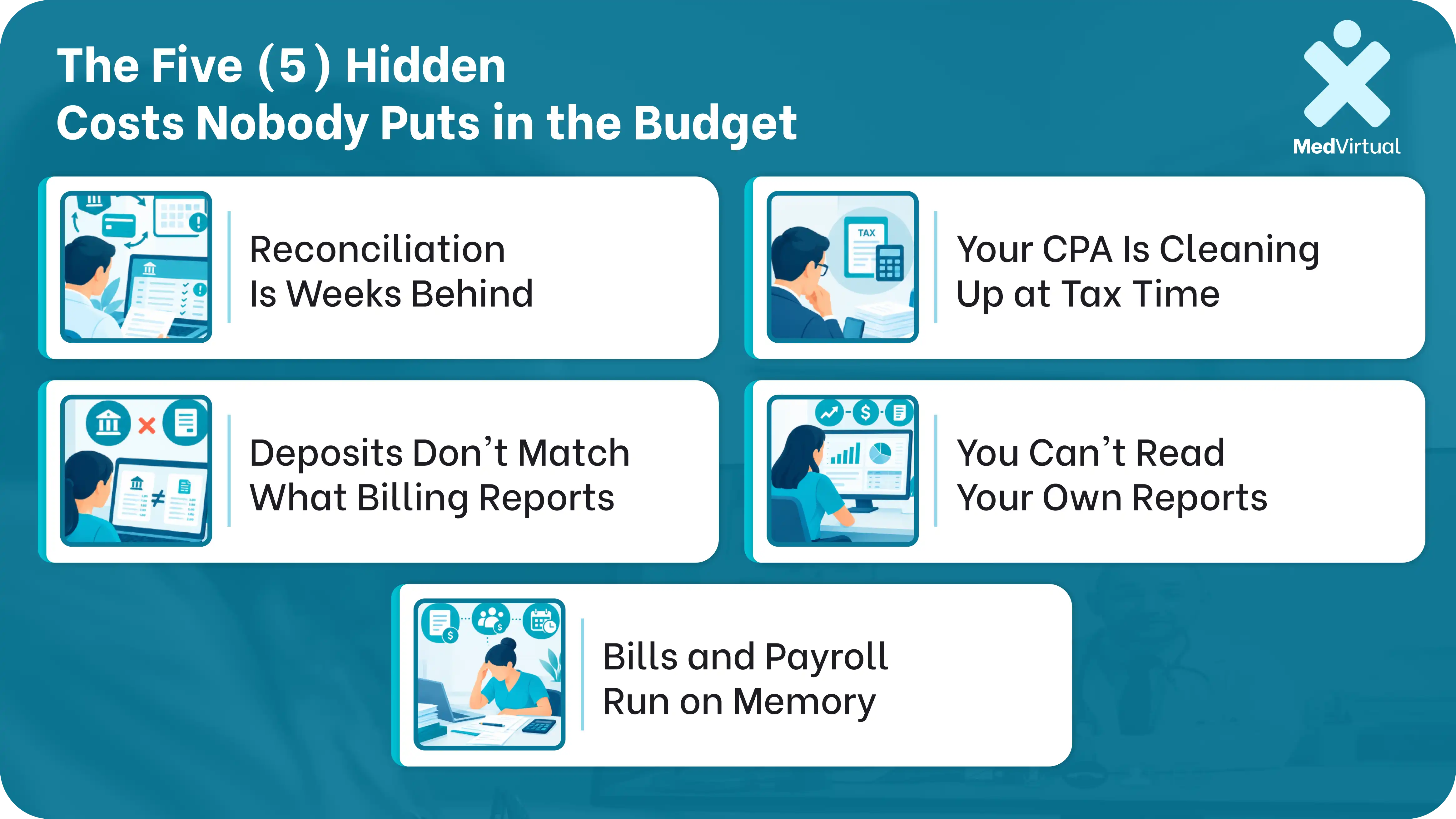
Reconciliation Is Weeks Behind
If bank and card accounts are not reconciled monthly, errors compound. Each unreconciled month makes the next one harder to fix.
Deposits Don't Match What Billing Reports
When the billing report and the bank disagree and no one can say why, the gap is usually unrecorded adjustments, refunds, or timing. A mismatch you cannot explain is a sign nobody owns the matching.
Your CPA Is Cleaning Up at Tax Time
If your accountant spends tax season fixing categories and missing entries, the books were not maintained during the year. That cleanup work costs more than regular upkeep.
You Can't Read Your Own Reports
Owners should be able to see revenue, expenses, and receivables by month. If the reports arrive late, look wrong, or nobody trusts them, the underlying bookkeeping needs attention.
Bills and Payroll Run on Memory
Payables paid late or twice, and payroll prepared from scattered notes, point to a process that depends on one person's memory. A repeatable routine fixes that.
Where the MedVirtual Bookkeeper Fits
The MedVirtual Bookkeeper is a virtual assistant placed in your practice for the recurring bookkeeping work listed on the role page. The role's scope covers daily transaction recording, accounts payable and receivable, bank and credit card reconciliation, insurance reimbursement tracking, payroll support, and monthly financial reporting.

The role covers bookkeeping, and approvals, tax, and strategy stay with you and your CPA.
Every MedVirtual virtual assistant is HIPAA-trained and works under a signed BAA before Day One, which matters when remittances and patient payments are part of the job. Confirm the exact scope for your practice on the role page before you decide, including how it divides work with your biller.
Billing and bookkeeping hand off to each other, so pairing the two roles keeps the handoff clean. See the Medical Billing Virtual Assistant role for the claims side, where payment posting and denials live.
Better Bookkeeping for Medical Practices
Better bookkeeping for medical practices starts with separating the three jobs: billing gets claims paid, bookkeeping records and reconciles what arrived, and accounting turns the books into decisions. Outsource the recurring work, and keep approvals and tax with the owner and CPA.
Book a Consultation to talk through which bookkeeping tasks fit your practice.
Your Guide To Common Questions & Solutions