MedVirtual Incubation Program: The 3 Phases

The MedVirtual Incubation Program is a structured 90-day onboarding framework built to take a newly placed virtual assistant from Day One to fully embedded in your practice, broken into three distinct phases with specific deliverables at each stage.
This article walks through exactly what happens in each phase of the MedVirtual Incubation Program, from initial setup through full-scale optimization, so you know what to expect before you ever book a consultation.
Key Takeaways
- The MedVirtual Incubation Program runs in three phases over 90-plus days: Setup and Stabilization (Days 1 to 30), Performance and Integration (Days 30 to 60), and Optimization and Scaling (Days 60 to 90+).
- Every phase has specific deliverables, not vague check-ins, including coaching reports, performance tracking, and a dedicated Client Success Manager.
- Practices using the program report an 8.1% decrease in appointment delays, a 22% increase in patient follow-ups, and a 23% decrease in admin time per patient.
- Every virtual assistant enters the program HIPAA-trained with a signed BAA already in place, before Day One.
Phase 1: Setup and Stabilization (Days 1 to 30)
The first 30 days of the MedVirtual Incubation Program focus on getting your virtual assistant fully operational inside your practice's actual systems, not just hired and left to figure things out. Most virtual staffing failures trace back to this exact window, when a new hire has access to systems but no real understanding of how your practice actually operates day to day.
During this phase, your practice receives:
System access setup
Your virtual assistant is provisioned with secure, role-based access to your EMR, scheduling software, and communication tools. Access is scoped to what the role requires, nothing broader, and every credential is logged from the moment it is issued.
HIPAA onboarding documentation
Compliance paperwork, including the signed Business Associate Agreement and HIPAA training records, is already in place before Day One. Your practice never has to chase down compliance proof after the fact.
Workflow documentation
Your practice's specific processes, from call scripts to billing procedures, are documented so your virtual assistant works your way, not a generic template. This documentation becomes a reference asset your practice keeps, independent of who is staffing the role.
Close monitoring for early issues
MedVirtual watches performance closely during this window and addresses small problems immediately, before they become larger ones. A missed step in week one gets corrected in week one, not discovered in week six.
NOTE: The goal of Phase 1 is stabilization. By day 30, your virtual assistant should be functioning inside your workflows with the basics fully in place, and your practice should already have a documented record of how the role operates.
Phase 2: Performance and Integration (Days 30 to 60)
Once the setup phase is complete, the MedVirtual Incubation Program shifts into measuring and refining how your virtual assistant is actually performing. This is the phase where a placement either proves its value with data or reveals a gap that needs correcting, and MedVirtual treats both outcomes as useful information rather than something to hide.
Deliverables during Phase 2 include:
Formal KPI tracking
Productivity and quality metrics are tracked from this point forward, not estimated after the fact. Your practice sees actual numbers tied to actual tasks, whether that is claims processed, calls handled, or appointments confirmed.
Dedicated check-ins
Your Client Success Manager holds direct conversations on a cadence that fits your practice, whether that is weekly, biweekly, or monthly. These are working sessions, not status updates read off a script.
Coaching reports
Coaching logs, engagement reports, and incident-based coaching notes give you full visibility into how your virtual assistant is developing. If a specific skill needs reinforcement, it shows up in the coaching record, not just in a conversation you were not part of.
Workflow refinement
Processes identified as inefficient during Phase 1 are adjusted so your virtual assistant's output keeps improving. Nothing documented in Phase 1 is treated as final; it is a starting point that gets sharpened here.
NOTE: By the end of Phase 2, your virtual assistant is not just present in your workflows. They are actively contributing measurable output, backed by data your practice can see, not adjectives from an account manager.
Phase 3: Optimization and Scaling (Days 60 to 90 Plus)
The final phase of the MedVirtual Incubation Program is where your virtual assistant moves from integrated to indispensable. By this point, the working relationship has enough history behind it to optimize with confidence instead of guessing.
Deliverables during Phase 3 include:
Standard operating procedures
MedVirtual helps build SOPs based on what has actually worked during the first 60 days, so your processes are documented for the long term. These SOPs outlast any single employee, virtual or in-house.
Full workflow optimization
Remaining inefficiencies are addressed, and your virtual assistant's role is refined to add the most value possible for your specific practice. What started as a general role description in week one is now a role tuned specifically to how your practice runs.
Client Success Manager transition
Strategic oversight continues, with your Client Success Manager positioned for long-term partnership rather than a one-time onboarding contact. The relationship does not end when the 90-day clock does.
Scaling readiness
If your practice is ready to add a second or third virtual assistant, the systems and documentation built during Incubation make that expansion faster. The groundwork for role two is already sitting in the SOPs built for role one.
NOTE: Phase 3 does not have a hard end date. The "90-plus" designation reflects that optimization is ongoing, not a box to check and forget. Practices that treat this phase as a starting point for continuous improvement tend to see the strongest long-term results from their virtual staffing investment.
The Results Behind the Incubation Program
The MedVirtual Incubation Program is not just a checklist. Practices that complete the full 90-day framework report measurable operational improvements:
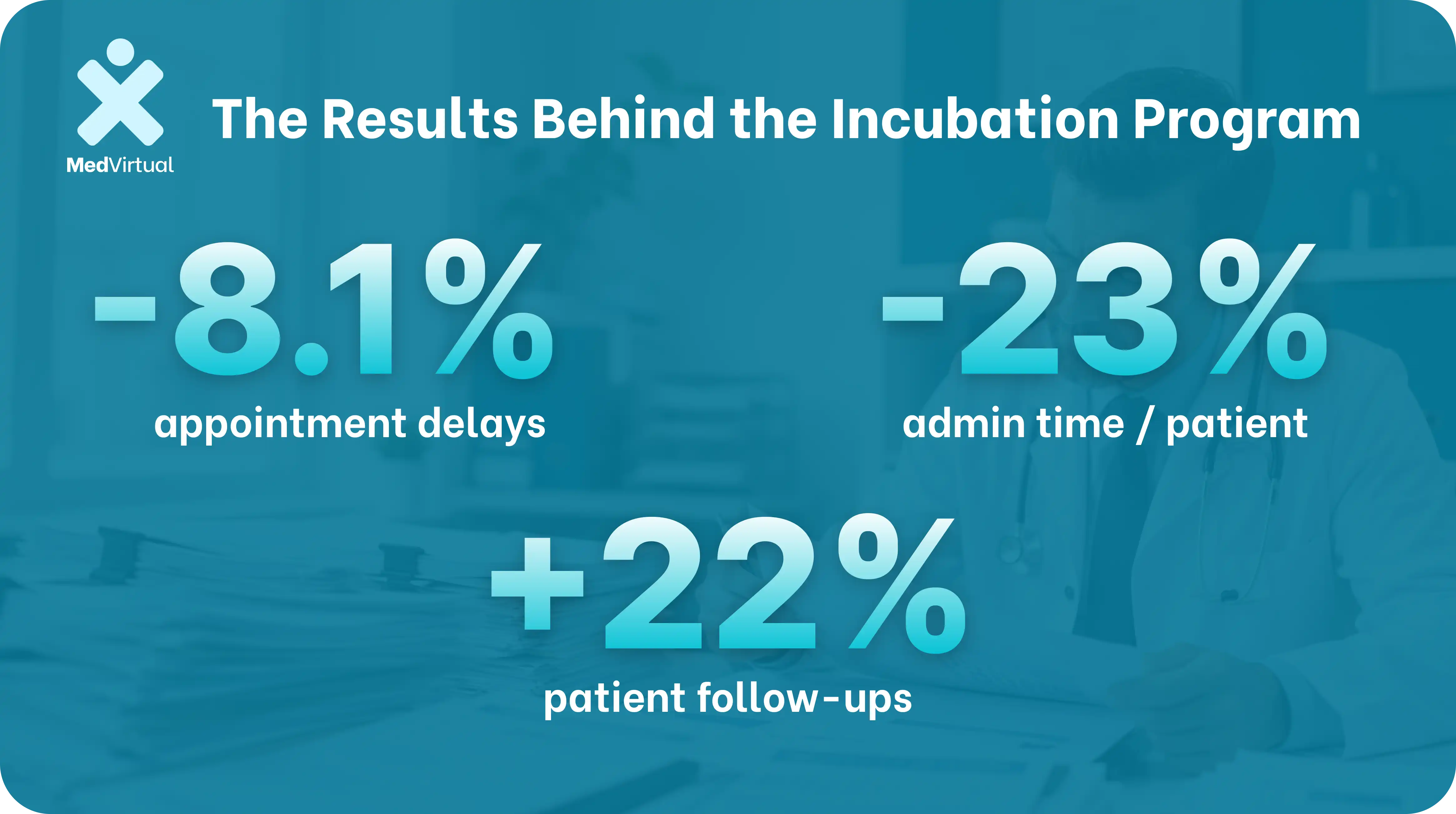
8.1% decrease in appointment delays over six months
as scheduling and confirmation workflows become more consistent. Fewer delays mean fewer frustrated patients and a schedule that holds up under real-world volume.
22% increase in patient follow-ups
as your virtual assistant takes on outreach and confirmation tasks that often fall through the cracks in a busy practice. Follow-up work that used to depend on whoever had a free minute now happens on a defined cadence.
23% decrease in admin time per patient
freeing your clinical staff to spend more time on care instead of paperwork. That time recovery compounds across a full patient panel, not just a single visit.
These figures are specific to practices going through the Incubation Program itself, not a general claim about virtual staffing broadly. They reflect what structured onboarding and ongoing coaching deliver over a six-month window, not just the first 90 days.
Why Structured Onboarding Beats a Standard Placement
Most virtual assistant companies treat onboarding as a single event: match a candidate, hand off credentials, and move on. The table below shows how that approach compares to the MedVirtual Incubation Program.
A placement without structured coaching is how virtual assistant hires quietly underperform. Nobody notices a slow decline in call quality or a missed follow-up pattern until it shows up in patient complaints or a claims backlog.
The MedVirtual Incubation Program is built specifically to prevent that outcome by catching drift early and correcting it before it compounds.
How to Get Started
The MedVirtual Incubation Program is included with every dedicated placement, across all virtual staffing roles, from Medical Admin to Healthcare Sales Virtual Assistant. There is no separate signup or add-on fee. Every practice that places a virtual assistant through MedVirtual moves through the same three phases described above.
To see how the full 90-day roadmap applies to your specialty and practice size, visit the Incubation Program page for a phase-by-phase breakdown, or book a consultation to talk through your specific workflows. There is no separate onboarding process to schedule; Incubation begins automatically the moment your virtual assistant is placed.
Start Your 90-Day Incubation
The MedVirtual Incubation Program turns virtual staffing into a structured, measurable process instead of a one-time hire and hope.

MedVirtual has supported 250+ US medical practices through this same three-phase framework.
Book a Consultation to see how Incubation fits your practice. See How It Works to explore the platform behind every placement.
Your Guide To Common Questions & Solutions