What Is a Virtual Medical Scribe and Who Needs One?
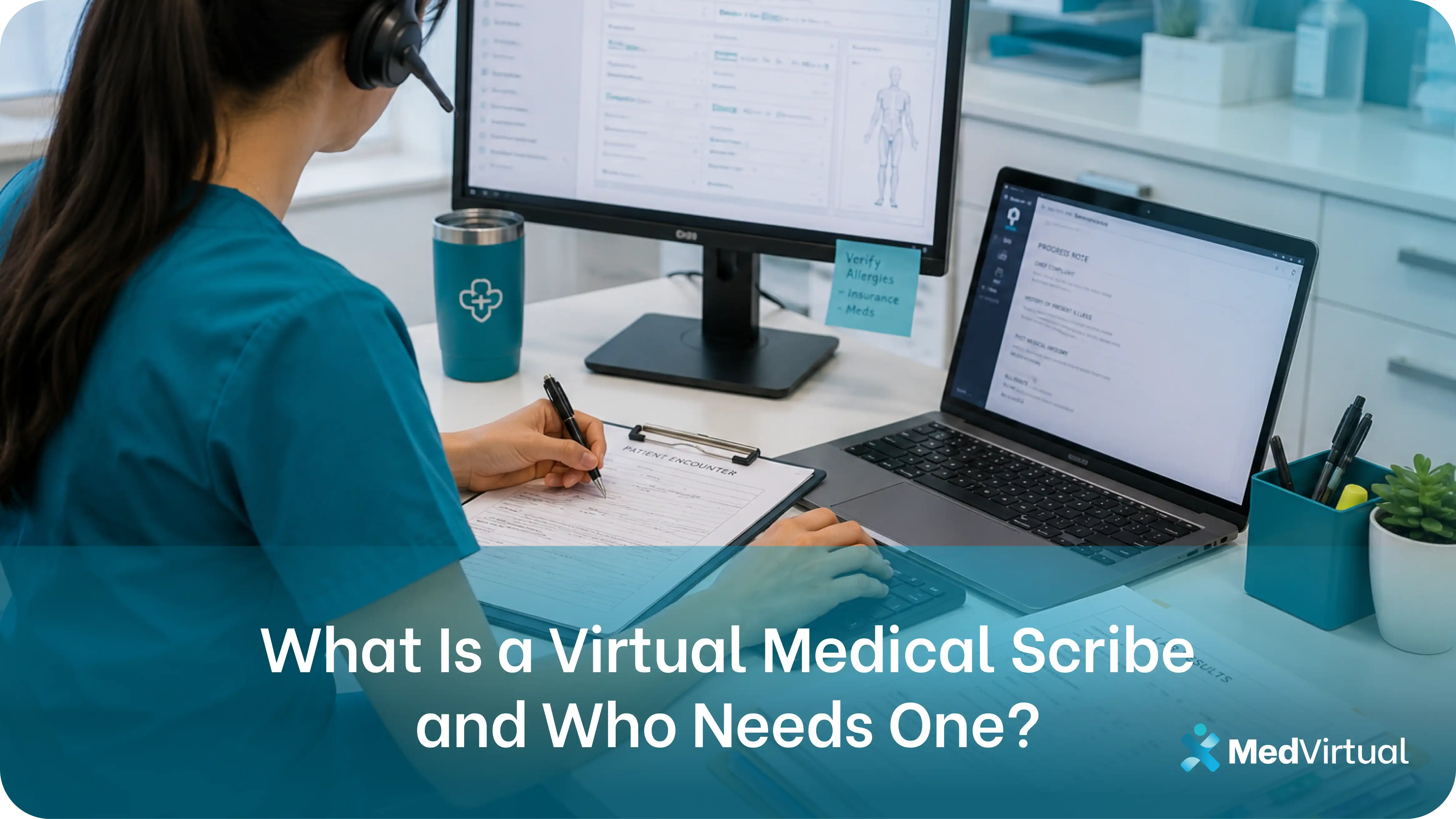
For most providers, the documentation problem is not new. If you are asking what is a virtual medical scribe, the answer is a HIPAA-trained professional who documents patient encounters in real time and enters notes directly into your EMR while you focus on the patient.
This article breaks down what a virtual medical scribe is, how the role works in a practice setting, which specialties benefit most, and how to know if your practice needs one.
Key Takeaways
- A virtual medical scribe is a HIPAA-trained documentation professional who joins patient encounters remotely via audio or video and enters clinical notes directly into your EMR in real time.
- The role eliminates after-hours documentation by closing notes during the encounter, not after it. Providers who currently finish charts in the evening or on weekends recover that time immediately.
- They are matched to your specialty's documentation standards before placement, not trained at your practice's expense after they start.
- Not every practice needs one. The role delivers the most value in high-volume specialty practices, telehealth programs, and any setting where documentation consumes meaningful provider time during or after clinical hours.
What Is a Virtual Medical Scribe?
A virtual medical scribe is a trained documentation professional who works remotely to capture patient encounter information and enter it into your electronic health record in real time.
During a patient visit, the scribe joins via an encrypted audio or video connection and listens to the provider-patient interaction. They document the encounter as it unfolds.
The subjective findings, objective data, assessment, and plan are entered directly into your EMR. When the visit ends, the note is complete.
The provider reviews and signs the note, not writes it.
The role is not new. Medical scribes have supported clinical workflows in emergency departments and specialty practices for years.
What changed is that the documentation function can now be performed remotely. None of the accuracy, accountability, or real-time value of an in-person scribe is lost.
This is not an AI transcription tool. AI tools generate draft notes from ambient audio that require provider review and correction before they meet documentation standards.
The scribe produces the final note during the encounter and takes accountability for its accuracy before it reaches your review queue.
The Day-to-Day Responsibilities of a Virtual Scribe
The core function is real-time documentation, but the scope extends across the full encounter cycle.
During the encounter
The scribe captures the provider-patient interaction, entering the clinical narrative into your EMR as the visit unfolds. Subjective findings, review of systems, physical examination findings, assessment, plan, and provider orders are documented in your preferred format.
Between encounters
The scribe manages chart-level tasks including updating problem lists, medication lists, and follow-up instructions. Notes are structured and complete before the provider moves to the next patient.
Order entry support
Lab orders, imaging requests, and referrals are entered into the EMR based on provider direction during the encounter. Administrative order entry is handled before the patient leaves the room.
After-visit documentation
After-visit summaries, patient instructions, and any post-visit correspondence are completed at the end of the session. Provider documentation time drops to review and sign only.
Pre-visit chart preparation
Patient charts are reviewed and organized before each encounter. Providers enter the room with full clinical context and no time spent locating previous notes.
Virtual Medical Scribe vs. In-House Scribe
The function is identical. The delivery model is different.
For practices where the provider sees patients in a single location throughout the day, a virtual scribe delivers the same documentation quality and encounter coverage at a lower cost. One connection replaces a workstation, a desk, and the payroll overhead of an in-house hire.
The key operational differences are connection method and setup. A virtual scribe requires a HIPAA-compliant audio or video connection and confirmed remote access to your EMR before the first encounter.
Both are arranged during onboarding. Once in place, the workflow is the same.
Virtual Scribe vs. AI Scribe Tools
AI scribe tools have become a frequently marketed alternative to human scribing. Understanding where they differ matters before a practice makes a staffing decision.
AI scribe tools
Use ambient audio to generate a clinical note draft. The provider reviews the draft, corrects errors, fills gaps, and approves the note before it enters the EMR.
The time savings depend entirely on the quality of the AI-generated draft and how much provider correction is required before the note is usable.
A virtual scribe
Produces the note during the encounter. The scribe listens with clinical context, applies your specialty's documentation standards, and enters a complete, structured note.
The provider reviews and signs a note that is ready, not a draft that needs editing.
The practical difference: AI tools shift documentation time from writing to editing. A virtual scribe eliminates the documentation step for the provider entirely.
Some practices use both. AI tools can accelerate transcription speed within a human-managed workflow, and understanding what each actually delivers matters before assuming one replaces the other.
Who Needs a Virtual Scribe?
Not every practice reaches a point where the documentation burden justifies a dedicated scribe. These are the situations where the value is clearest.
Providers finishing charts after hours
If your providers are completing clinical notes in the evenings or on weekends, a virtual scribe closes that gap immediately. Every note closes during the encounter, and the workday ends when the last patient leaves.
High-volume specialty practices
Specialties with detailed, structured encounter documentation (orthopedics, neurology, cardiology, pain management) generate note complexity that compounds during high-volume days. A dedicated scribe maintains documentation quality regardless of patient volume.
Practices transitioning to a new EMR
Documentation speed drops during any EMR transition, and provider time absorbed by navigation and data entry has a direct cost in productivity. A scribe absorbs that burden so providers adapt without losing charting ground.
Telehealth-only and hybrid practices
Virtual encounters require the same clinical documentation as in-person visits. A virtual scribe works remotely and integrates into a digital encounter workflow naturally.
Practices where note quality is inconsistent
When providers rush through documentation between patients, note completeness and coding accuracy suffer. A dedicated scribe who knows your specialty's documentation standards produces more consistent notes and better supports accurate coding.
What to Look for When Hiring a Documentation Specialist
The quality of the placement determines whether scribing works for your practice.
Specialty-specific documentation experience
A scribe who knows how to document a straightforward primary care SOAP note may not know how to document an interventional pain management procedure or a complex neurological workup. Verify that candidates have direct experience in your specialty's documentation patterns before placement.
EMR proficiency
The scribe must have hands-on experience in the specific EMR your practice uses, not general EHR familiarity. Confirm this during the matching process.
HIPAA compliance and BAA
Every scribe who joins a patient encounter is handling Protected Health Information. A signed Business Associate Agreement must be in place before the first encounter, along with documented HIPAA training, encrypted connection protocols, and role-based access controls.
Connection method and setup
Confirm how the scribe will connect to encounters (audio line, video, or platform-integrated connection). The setup must meet HIPAA requirements for your practice's workflow before going live.
Accountability structure
Understand how the staffing partner handles performance issues and what happens if the placement is not the right fit. A guaranteed replacement at no extra cost is the standard in a credible dedicated placement model.
What Is a Virtual Medical Scribe Next Steps?
In short, a virtual medical scribe is a HIPAA-trained documentation professional who closes your clinical notes in real time, not after hours.
MedVirtual places dedicated, HIPAA-trained virtual medical scribes pre-matched to your specialty and EMR. Most practices are live within 3 to 5 days of the consultation.
Read What Does a Virtual Medical Scribe Do? for a detailed breakdown of the role's daily functions. When you are ready to explore placement, book a consultation to discuss your specialty, EMR, and documentation volume.
Your Guide To Common Questions & Solutions